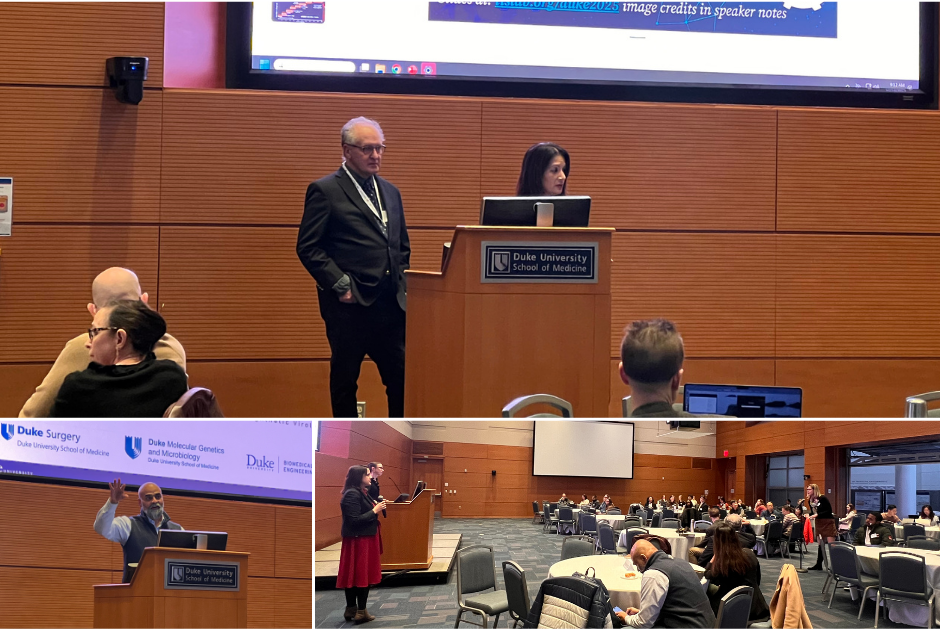
The Duke University School of Medicine has a strong tradition of genomic discoveries. The Precision Genomics Collaboratory brings together all of the units in Duke focused on genomics research to create a multi-disciplinary community able to tackle challenges in the ever-evolving genomics landscape.
Featured Publication
Mechanosensitive genomic enhancers potentiate the cellular response to matrix stiffness
Charlie Gersbach, Greg Crawford, Purushothama Rao Tata, Yarui Diao, and colleagues discovered how physical forces in a cell’s environment, like stiffness or softness, can affect gene activity. They discovered special DNA regions, called mechanoenhancers, that turn genes on or off depending on the mechanical cues in the cellular microenvironment. Mechanoenhancers control important cell behaviors such as growth, movement, and survival, and by editing them, scientists were able to change how lung cells respond to mechanical stress, which could lead to new treatments for diseases caused by abnormal tissue stiffness, like fibrosis.
Funding Opportunity
Duke-Coulter Translational Partnership Grants
The Wallace H. Coulter Endowment at Duke University provides funding to support collaborative translational research projects that involve Duke faculty from the Department of Biomedical Engineering (BME) and a clinical department in the School of Medicine. The goal of this program is to accelerate the development of promising bioengineering research that addresses unmet clinical needs and leads to improvements in health care and to commercial products.
Deadline: May 14, 2026
Our Community
Duke Molecular Physiology Institute
Duke Center for Advanced Genomic Technologies
Duke Center for Genomics and Computational Biology
Duke Center for Statistical Genetics and Genomics
Center for Precision Health
Duke Microbiome Center
Division of Integrative Genomics in the Department of Biostatistics & Bioinformatics
Division of Human Genetics in the Department of Molecular Genetics and Microbiology
Division of Medical Genetics in the Department of Pediatrics
Adult Cardiovascular Genetics Clinic
Clinical Cancer Genetics