
Artificial Intelligence platforms can plan trips, budget finances, provide directions on how to repair broken appliances and devices, and so much more. But how much can health care providers actually trust the information it generates in a clinical setting?
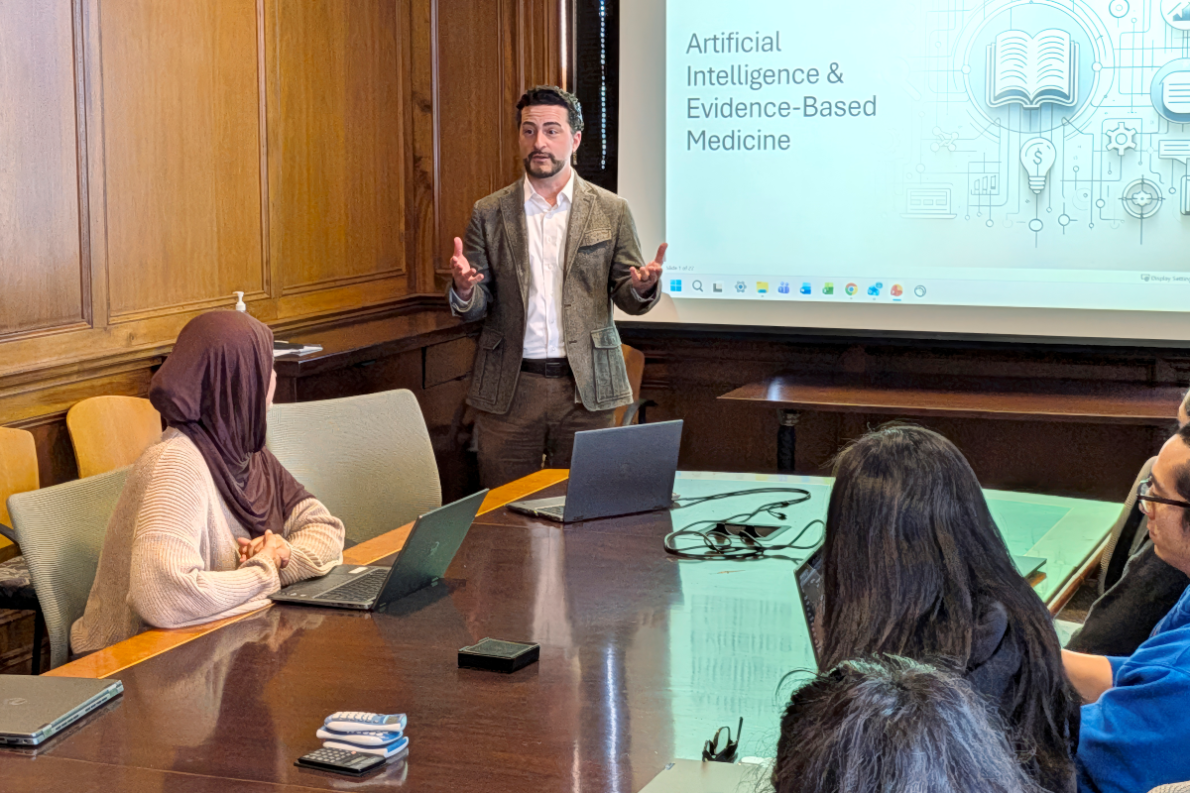
Nicholas Hudak, PhD, PA-C, professor in family medicine and community health, is helping physician assistant (PA) students answer that question through a 4-hour seminar.
“Their careers are starting really at the advent of AI. It's incumbent upon educators to be proactive, so we're not just trying to keep up with our learners but instead, are leading them in using it,” Hudak said.
PA students learn about the strengths and limitations of AI through an introductory presentation, individual practice, and reflection with classmates. “An analogy that I tell my students is that we’re playing in the sandbox. We're not going to master AI, but we are testing out the tools and gaining some exposure,” Hudak said. For many of his students, it was the first time they used AI in their clinical education.
Hudak has been a physician assistant in neurology for the past 21 years and has been training Duke students since 2009. “For most of my life, I've been a late adopter with technology. I got rid of my flip phone when the iPhone 6 was out,” Hudak said. But his approach changed once AI began making its way into the medical profession.
He started hearing from his students that they and other clinical instructors were beginning to incorporate AI tools into their practice. “My students would say, ‘We checked PubMed, and we checked practice guidelines, but let's see if AI has anything to add about this,’” Hudak recalled. His neurology patients were also beginning to come to him with information they learned from AI systems.
With AI’s tendency to hallucinate and at times, produce fake studies, Hudak quickly recognized a growing need to intervene. “I realized that we needed to be proactive in preparing future clinicians and current clinicians to use these tools responsibly because this information could be used to influence decision making,” he said.
Hudak designed the Artificial Intelligence and Evidence-Based Medicine: A Seminar in 2024 and piloted it in the Spring of 2025. It takes place during a 4-week, evidence-based practice course offered to second-year physician assistant students. During the course, students learn about the traditional evidence-based medicine cycle, which involves gathering the best available evidence, critically appraising the literature, and applying research findings to a clinical scenario.
In Hudak’s interactive seminar, students revisit the steps in the evidence-based medicine cycle for their individual project while using AI platforms. “Students compare the long form work that they did to the short form work the AI platform produced and use that to determine that platform’s accuracy,” Hudak said.
Students prepare for the seminar by first watching a recorded presentation about how AI technology works and the current platforms available. There is also a required reading about the intersection of AI and health care, and how AI can be used to support clinical decision making. Students are encouraged to pay close attention to the sources these platforms use to generate responses during practice activities.
At the end, students share what they learned during group reflection and leave with the ability to model proper and responsible use of AI technologies for patients.
“We want to be trusted partners for our patients and trusted messengers of scientific information, but also we need to always be critiquing the trustworthiness of the information we're looking at online, what we hear from people in our lives, and certainly what patients are hearing from clinicians,” Hudak said.
While the course was designed specifically for physician assistant students, Hudak welcomes and encourages collaboration with educators in other health professions. “Health care is delivered by teams of clinicians, and for me, it's very important for us to learn from each other and how we're teaching our learners. Not only do we need to show what we're doing, but also share it,” Hudak said.
The seminar is supported by an AI Jump Start Grant from the Duke Center for Teaching and Learning (formerly Learning Innovation & Lifetime Education).