
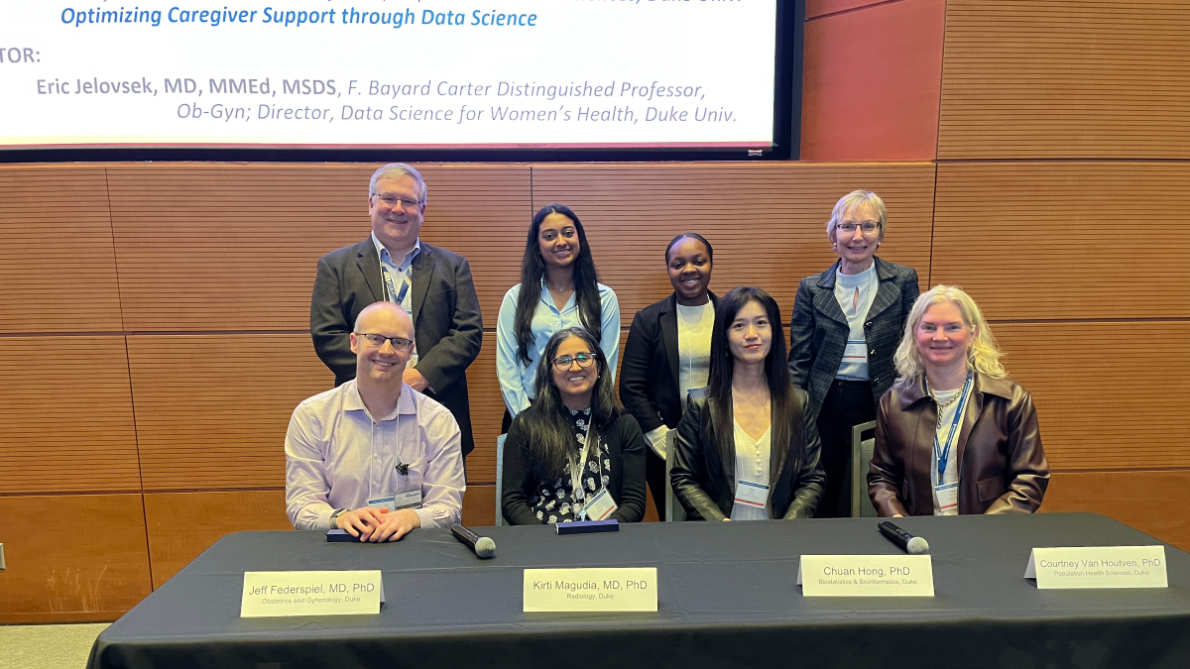
Physicians and researchers from across the region gathered Feb. 6 at the Duke Women’s Health Symposium to examine the limited depth of research focused on women’s health and to showcase the data-driven tools they believe can finally change that.
More than 145 attendees joined the event, hosted by Duke’s Building Interdisciplinary Research Careers in Women’s Health K12 (BIRCWH K12) program. It opened with a deep dive into data science — one of the National Institutes of Health’s top strategic priorities for expanding women’s health.
From maternal outcomes to cancer survivorship, researchers are now using artificial intelligence, digital health records, and advanced imaging to transform how women’s health is studied and treated.
“We were extremely pleased with the participation this year by faculty, trainees, students and other researchers from academia, industry and government representing 14 different institutions and more than 30 subspecialties,” said BIRCWH K12 program director Cindy Amundsen, MD, a professor of obstetrics and gynecology and urology at Duke University School of Medicine.
A panel moderated by Duke Health OB-GYN John Eric Jelovsek, MD, director of Data Science for Women’s Health, focused on the rapidly evolving ways computational methods are impacting studies of pregnancy, chronic disease, and caregiver burden.
Among the Duke panelists, maternal-fetal physician Jeff Federspiel, MD, described how electronic medical record data can unlock new insights into pregnancy outcomes that have been stubbornly difficult to improve. Biostatistician Chuan Hong, PhD, highlighted AI-driven models that could strengthen clinical communication for women navigating complex care, while radiologist Kirti Magudia, MD, PhD, showcased CT-based body composition techniques that could guide patient selection for bariatric surgery and lung transplantation.
Population health scientist Courtney Van Houtven, PhD, emphasized how data analytics can strengthen support for caregivers — a role most often filled by women and long overlooked in research.
Rebecca Kameny, PhD, career development specialist for BIRCWH K12, said Duke University’s ability to bring together experts from its schools of medicine, nursing, engineering, and Trinity College, along with collaborators from North Carolina Central University, helped create a wide-ranging exchange.
“There is strong interest in exploring the breadth of women’s health research and connecting with leaders in the field,” said Friederike Jayes, DVM, PhD, BIRCWH K12 program coordinator and reproductive sciences researcher.
The symposium also showcased early-career investigators supported through the BIRCWH K12 scholars program, which pairs protected research time with intensive scientific mentorship. Three scholars presented new findings on conditions that disproportionately affect women and girls.
-
Lindsay Edwards, MD, Department of Pediatrics: AI-enhanced risk stratification of cancer therapy-related cardiomyopathy among childhood cancer survivors
-
Tarannum Jaleel, MD, MHSc, Department of Dermatology: Menstrual cycle and skin inflammation
-
Rebecca Sadun, MD, PhD, Department of Medicine, Division of Rheumatology: Measuring adherence and fatigue in children, teens, and young adults with lupus in pursuit of improved disease outcomes
A second panel featured BIRCWH K-12 alumni who are now advancing women's health at the Department of Veterans Affairs, major universities and health care companies.
Main Photo: Front row, from left Jeff Federspiel, MD, PhD; Kirti Magudia, MD, PhD; Buan Hong, PhD; and Courtney Van Houtven, PhD, and back row, from left, Eric Jelovsek, MD, MMEd, MSDS; Duke University student Arshia Zaidi; NCCU student Ashley Whitfield; and Cindy Amundsen, MD.