
Some 4,500 years ago, give or take a few centuries, a Mesopotamian king named Gilgamesh, grief-stricken over the death of his closest friend and desperate to avoid the same fate, embarked on a long quest in search of the secret of eternal life.
According to the ancient epic poem that bears his name, Gilgamesh — spoiler alert — failed in his quest. But, as psychologist
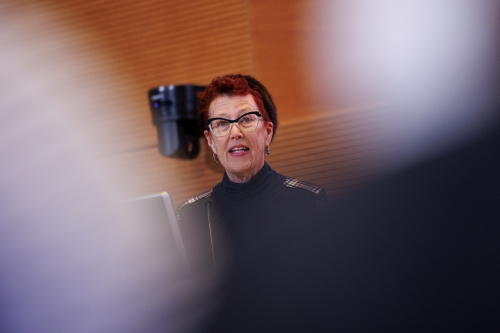
Terrie Moffitt, PhD, noted at the School of Medicine’s 2026 Research Symposium on Feb. 5, the dream of everlasting life has never died.
“Will we humans ever achieve immortality through geroscience and the longevity industry?” said Moffitt, whose research has helped transform the study of human aging. “Humans have been hoping for this since at least 2000 BC.”
Immortality, at least for now, remains out of reach. But the quest to understand the aging process and extend not only life span but what many researchers call health span is a burgeoning scientific field that is rapidly yielding breakthroughs in knowledge and promising therapeutic approaches.
This year’s symposium, “Metabolism and Health Across the Lifespan,” highlighted Duke research that informs efforts to extend and enhance both longevity and late-life health. Duke scientists addressed topics ranging from how to measure the pace of aging to how to train fat tissue, from neurodegeneration to the mechanisms that drive GLP-1 drugs.
School of Medicine Dean Mary Klotman, MD, executive vice president for health affairs, noted that metabolism — broadly, the complex processes by which the body generates and uses energy — is the common denominator linking the diverse fields.
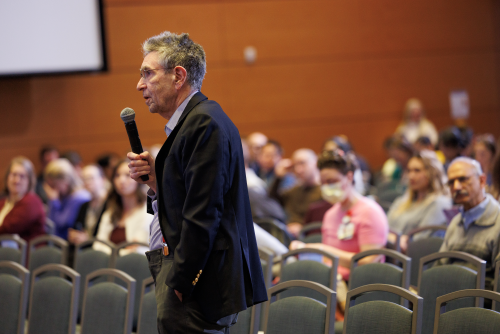
“What will come to light today is how many different areas of science are based on fundamental discovery science in metabolism,” Klotman said, welcoming the large audience in the Great Hall of the Trent Semans Center. “It is an area of science that is fundamental to many disciplines, but that also aligns discovery science with clinical science, another aspect that is woven into the culture at Duke.”
Christopher Newgard, PhD, the W. David and Sarah W. Stedman Distinguished Professor of Nutrition and director of the Duke Molecular Physiology Institute (DMPI), organized and led the symposium.
“At the Stedman Center and the DMPI, we increasingly have joined forces with other emergent and vibrant programs in aging research, effects of evolution on metabolism, cardiology, nephrology, and gut neurobiology to create a strong presence at Duke that is recognized nationally and worldwide,” Newgard said. “The philosophy that we try to represent is that dysregulated metabolism is a component of essentially all chronic human disease, and in many cases presents therapeutic opportunity.”
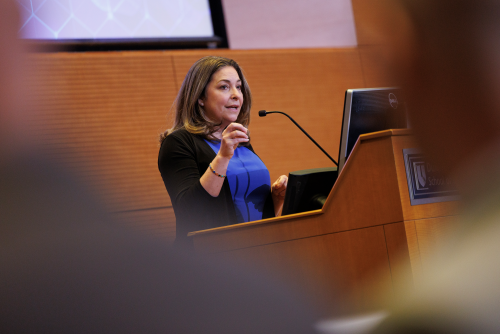
Heather Whitson, MD, MHS, School of Medicine Distinguished Professor in Neuroscience and director of the Duke Center for the Study of Aging and Human Development, hit on a common theme in noting that conditions and experiences in early and mid-life play an enormous role in shaping health in later life. That fact, she said, presents exciting opportunities to develop interventions that can influence the pace of biological aging.
“Our goal is to try to bend people’s trajectories so they’re closer to the super-ager curve and we’re slowing the pace of aging,” said Whitson, co-director of the Duke-UNC Alzheimer’s Disease Research Center (ADRC). “To do that, we need to understand the molecular and cellular drivers of the biological pace of aging. As we understand the levers of these biological processes, we have the opportunity to potentially engineer more youthful biology.”
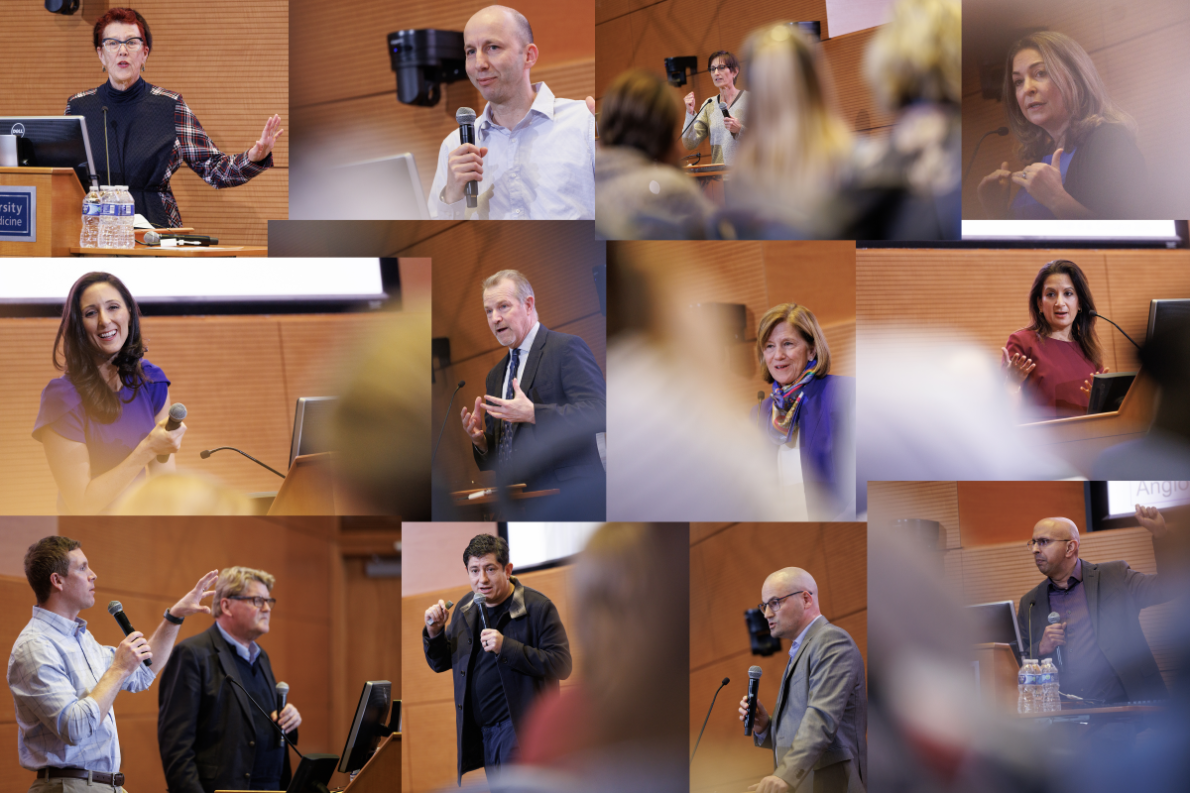
The symposium featured research presented by:
-
Terrie Moffitt, the Nannerl O. Keohane Professor of Psychology, whose research with Avshalom Caspi, PhD, Edward M. Arnett Professor of Psychology and Neuroscience, has shed important light on the difference between chronological aging — the steady rate at which we grow older according to the calendar — and biological aging — the more variable rate at which our cells, organs, tissues and systems age.
-
Leanna Ross, PhD, assistant professor of medicine, who shared research on the “legacy health effects” of exercise, suggesting that even a relatively brief eight-month period of vigorous exercise generates cardiovascular improvements that can last a decade or more — and that a second round of exercise at that point might boost health even higher.
-
Svati Shah, associate dean for translational research, director of the Duke Precision Genomics Collaboratory, and Ursula Geller Distinguished Professor of Research in Cardiovascular Diseases, who shared insights into the therapeutic potential in the cardiac metabolic pathways associated with fatty acids and ketones.
-
Herman Pontzer, PhD, professor of evolutionary anthropology, whose research on energy expenditure explores the parameters, causes, and consequences of what he defines as the four metabolic phases of life: the first year of life; childhood to age 20; a long stable period from ages 20-60; and then a decline after 60.
-
James White, PhD, associate professor of medicine, whose research indicates that controlled caloric restriction is the most effective tool thus far discovered for extending longevity. He and his team are exploring the processes that drive these effects and potential therapeutic applications.
-
Deborah Muoio, PhD, George Barth Geller Professor of Cardiovascular Disease, who explores how lifestyle factors influence mitochondrial fitness and how that interaction affects cardiovascular health and disease.
-
Rana Gupta, PhD, W. David and Sarah W. Stedman Distinguished Professor of Medicine, who shared his research on the plasticity of adipose tissues and how specific interventions might make them more metabolically resilient.
-
David D’Alessio, MD, Lindquist Presidential Distinguished Chair of Medicine, who discussed the physiology of GLP-1 drugs for diabetes and weight loss, as well as the variation in sensitivity to side effects from those drugs.
-
Jonathan Campbell, PhD, associate professor of medicine, who shared his research on the functional implications of biased signaling in the GLP-1 receptor.
-
Diego Bohorquez, PhD, associate professor of medicine, cell biology, and molecular genetics and cell biology, who identified the neurobiotic sense, a neural circuit that communicates between the gut and the brain.