
Duke University School of Medicine has launched Discovery AI, an ambitious research initiative that aims to accelerate the application of artificial intelligence (AI) and machine learning to discovery science in biomedicine.
The initiative will support recruitment of faculty with expertise at the intersection of AI and biology to be embedded in basic science departments.
It will also provide shared computational resources, a seminar series, coding bootcamps, and access to cutting-edge laboratory technologies. These include existing core facilities in genomics and sequencing, microbiomics, proteomics, metabolomics, advanced imaging and microscopy, CryoEM, and emerging platforms for protein design and engineering.
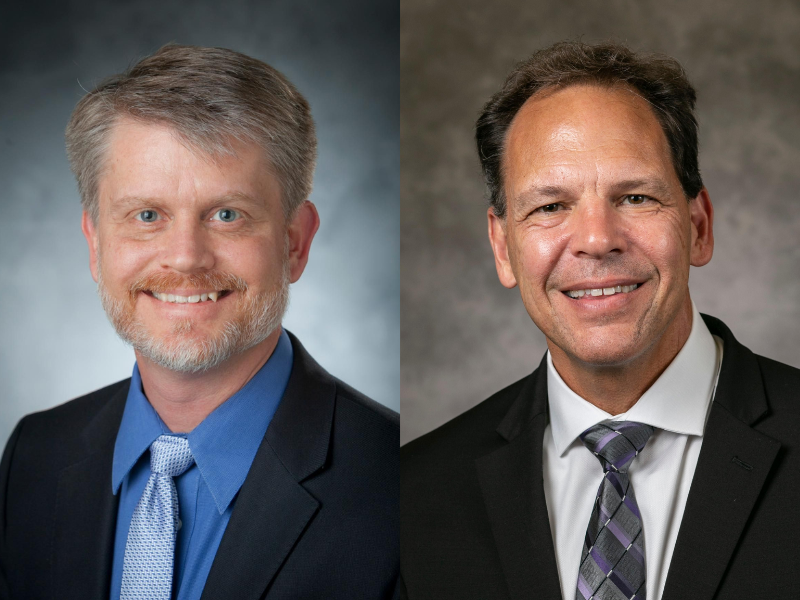
This new effort is largely the vision of Scott Soderling, PhD, chair of the Department of Cell Biology, and David Page, PhD, chair of the Department of Biostatistics and Bioinformatics, who will co-lead it.
“Duke is already tackling the biggest questions in biomedical research,” Soderling said. “By embedding AI experts with basic researchers, we hope to use everything we know about how cells work and then apply AI to reprogram diseased cells back to a healthy state.”
As Page puts it: “We want to make generative AI truly generative — not just for text, but for molecules and treatments.”
Though it’s based in the School of Medicine, Discover AI is a campus-spanning effort that draws on Duke’s strengths in fields such as machine learning, structural biology, neuroscience, microbiology, genetics, immunology, development, and cell biology.
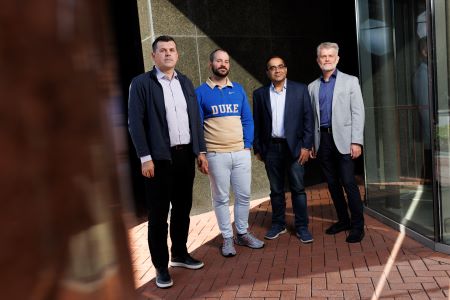
The initiative has already recruited two leaders in the field who specialize in protein language models and protein design — Rohit Singh, PhD, and Christian Dallago, PhD. Mihai Azoitei, PhD, moved from the Department of Medicine to the Department of Cell Biology to join this effort.
Future hires will bring expertise in cell foundation models, agentic AI, and conditional generative models, Soderling said. Together, these teams will tackle challenges like designing biologics and predicting cellular behavior with unprecedented precision.
Singh, a full-time assistant professor, was recruited from MIT’s Computer Science AI Lab, and has created several new AI tools. His models developed at Duke can re-design proteins to improve their therapeutic performance, uncover subtle changes in proteins that can lead to disease, and decode cell signaling. “Now, imagine if we could create new proteins and therapies using AI — and then synthesize and test them right here at Duke,” he said.
Dallago was recruited as visiting assistant professor and is excited to take machine learning beyond understanding protein structure. “Proteins are complex operating systems. To truly understand them, we need to work side-by-side with biologists in the lab,” he said. “That’s how we make sure the tools we build are useful.”
Azoitei, an associate professor of cell biology, designs protein-based vaccines and proteins that sense cell signaling. He trained at the University of Washington, with David Baker, PhD, who shared the Nobel prize in 2024 for protein structure prediction and design. He sees promise in the ability of AI to accelerate therapeutic discovery and to make protein modeling and design accessible to scientists without computational expertise.
Colin Duckett, PhD, executive vice dean for basic and preclinical science, has worked closely with Soderling and Page to bring the Discovery AI Initiative to life. “This initiative reflects what I think is really one of Duke’s key institutional strengths – our commitment to team science and collaborative projects that bring to bear the skills and perspectives from different but complementary domains,” he said.