

When you feel toothpaste's minty tingle, it's caused by the opening of a molecular "door" found in sensory nerve cells in your mouth. In 2022, Duke biochemists captured images of this door, a protein known as TRPM8, moving from closed to open in response to synthetic cooling chemicals.
This "door" is an ion channel, a protein that controls the flow of charged particles into nerve cells. When it opens, those particles trigger signals to the brain that are perceived as cool sensations.
Now, the same researchers have gone a step further, revealing how the channel responds to physical cold, uncovering something unexpected about how it works: cooling physically reorganizes the channel's pore (the opening through which ions pass), transforming it from a flexible, closed structure into a more ordered, open state.
TRPM8 channels are found in the skin and eyes as well as the mouth, and abnormal signaling through them has been implicated in conditions including chronic pain, migraine, dry eye disease, and some cancers. Understanding exactly how the channel works could help researchers develop more targeted therapies.
The researchers, led by senior author Seok-Yong Lee, PhD, used cryo-electron microscopy (cryo-EM) to capture high-resolution snapshots of TRPM8 as it transitioned from closed to open in the presence of both actual cold and chemical cold (menthol). They used both because they reinforce each other’s effects. The combination allowed enough channels to enter the open state for the team to image them with cryo-EM.
The results are published in Nature Communications.
While both cold and menthol ultimately open the same pore and trigger a cool sensation, they do so through somewhat different chains of molecular events along the way.
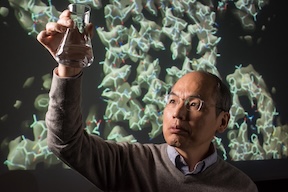
The researchers found that cold triggers structural changes in regions of the channel involved in opening the pore. By contrast, menthol binds elsewhere on the protein and induces shape changes that eventually lead to the same result: an open channel.
"Previously, there was no understanding of how cold activates this channel at the molecular level," Lee said. "Now we discovered that cooling physically remodels the channel’s pore. This remodeling directly explains the physics behind human cold sensation.”
Other Duke authors: Hyuk-Joon Lee, Cheon-Gyu Park, Justin G. Fedor.
Funding: The National Institutes of Health (NIEHS and NCI).