
Turning Down the Dial on Atherosclerosis

Almost everyone, if they live long enough, will develop some degree of atherosclerosis. Most will experience few or no symptoms, but when these plaques accumulate to the degree that they significantly restrict or block the flow of blood, the result is heart disease, heart attack, or stroke. Atherosclerosis is the primary underlying cause of cardiovascular disease, the world’s No. 1 killer.
For decades, cardiologists attempting to lower the incidence of heart conditions have focused on reducing low-density lipoproteins (LDL) — the familiar “bad cholesterol” — because oxidized LDL triggers the chronic inflammation that drives plaque formation in arteries.
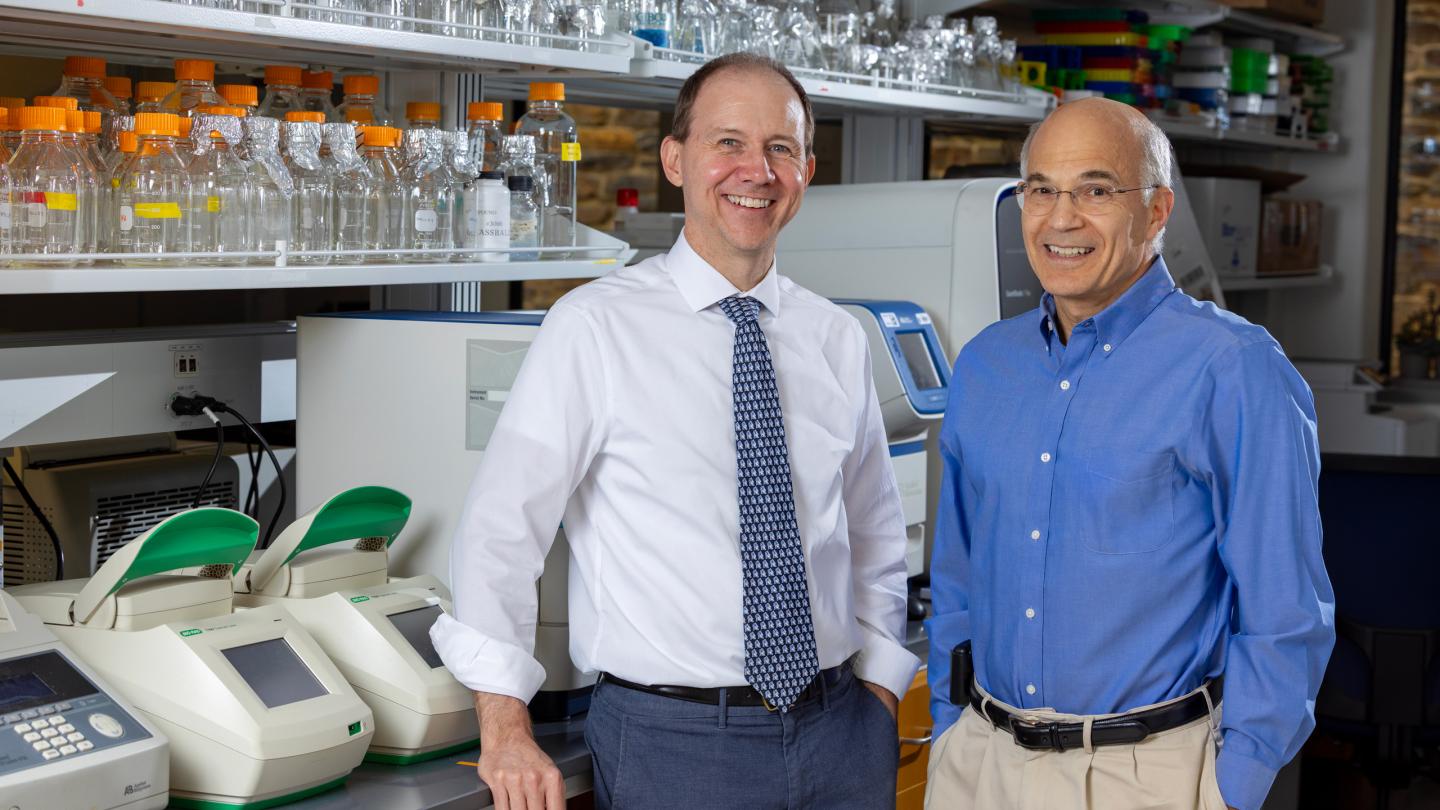
Two Duke researchers are taking a different approach, opening a new therapeutic front in the war on heart disease, born from basic research and a little serendipity.
Associate professor of medicine Chris Holley, BS’95, PhD’03, MD’04, was studying lipotoxicity, the cellular damage caused by excess fatty acids, when his lab discovered a particular genetic locus that, when disrupted, appeared to render cells highly resistant to oxidative stress. Surprisingly, the genes in question weren’t protein-coding genes but a cluster of small non-coding RNAs — snoRNAs — that seemed to regulate oxidative stress in multiple tissue types.
Professor of medicine Neil Freedman, MD, HS’90-93, attended a lecture by Holley one day in which Holley related that when his team had removed these snoRNAs from mice, they showed greatly lowered oxidative stress. For Freedman, who studies the genetics and signal transduction of atherosclerosis, a light went on.
“I came up to Chris after his great lecture, and I said to him, ‘You know, this could have wonderful implications for vascular inflammation and atherosclerosis,’” Freedman said. “Chris said, ‘Sure, let’s give it a try.’ And that’s how we got started.”
Together they launched a collaborative research program to explore the ramifications and potential therapeutic applications hiding in snoRNAs. When they fed mice lacking snoRNAs a high-fat, high-cholesterol diet, which would be expected to induce atherosclerosis, the results were striking.
“The mice without snoRNAs develop much, much less atherosclerosis, on the order of 50-60 percent less,” Holley said. “They get very, very high cholesterol, but they are still protected against atherosclerosis.”
This is what makes the discovery so compelling: the protection occurs even without lowering LDL cholesterol. That sets it apart from statins, PCSK9 inhibitors, and other current therapies that all work by reducing LDL levels. Deleting the snoRNAs dampens the inflammatory response rather than cholesterol levels.
“It’s a completely different mechanism than what we’re using to treat people now,” Holley said. “The idea is that if we can develop a therapy that does the same thing that we have in these knockout mice, then maybe we can use that as an additive therapy for people that have atherosclerosis and try to reduce their future risk.”
Supported by the federal government funding, philanthropy, and Duke’s research centers, the team hopes to ready this RNA-based strategy for eventual human testing.
Numerous challenges remain: for one thing, humans have four snoRNAs in this locus, meaning a therapy might have to target all four. But if successful, the snoRNA approach could become a powerful tool to complement therapies like statins by targeting the inflammatory engine of atherosclerosis.
Targeting oxidative stress in atherosclerosis is not new, Freedman said. But previous antioxidant therapies have used supplements and similar measures, which typically act like an off-switch for targeted molecules. Notably, snoRNAs behave differently: instead of switching off a single protein, they subtly reshape the entire protein landscape of a cell. The effect is cell-specific, coordinated, and —crucially — balanced.
“We’re not flipping an on or off switch,” Freedman said. “What we’re doing is more like dimming a rheostat on oxidative stress. We are altering, in small ways, a bunch of enzymatic processes that work continuously. An on-off switch is an unproductive way to regulate metabolic processes. Our cells need oxidation to function normally. We’re trying to harness the good side of that process while minimizing the damaging side.”