

Breaking Down Barriers to Care

What keeps Nishant Shah, MD, up at night? Thinking about all the missed opportunities to prevent heart attacks. “Heart disease remains the number one killer across the globe and many of the risk factors, like high cholesterol, are preventable,” said the Duke cardiologist.
Cholesterol-lowering drugs can reduce a person’s chances of developing heart attacks and strokes, and also vascular dementia, by preventing plaque from building up on the walls of blood vessels.
But too many patients who could benefit aren’t being treated. Shah, an associate professor of medicine, recently led a study following almost 2 million patients at 16 academic health centers, and found that slightly less than half of patients with known heart disease and high cholesterol were taking medications to lower their cholesterol.
“The study shows a problem across multiple health systems,” he said. “We aren’t controlling cholesterol the way we need to.”
Shah hopes to develop interventions that will help health systems be more effective at controlling cholesterol levels among patients, with the ultimate goal of reducing heart attacks across the country.
The topic is especially timely because new cholesterol guidelines have just been released by the American College of Cardiology and the American Heart Association. The new guidelines recommend aiming for lower levels of LDL, commonly known as “bad” cholesterol. “There is more and more evidence that the lower your cholesterol is, the better it is for you,” Shah said.
According to the new guidelines, patients at very high risk (those with both prior cardiac events and multiple risk factors) should aim for an LDL of less than 55 mg/dL. Those at high risk (with either prior cardiac events or multiple risk factors) should aim for less than 70 mg/dL. Otherwise, patients should aim for less than 100 mg/dL. To determine risk, the guidelines recommend a tool called PREVENT-ASCVD, which assesses blood pressure, glucose levels, BMI, age, gender, and other factors to generate a more accurate level of risk. In case of uncertainty, coronary calcium tests can help refine risk.
The guidelines also recommend screening and treating earlier, because the negative effects of high LDL cholesterol accumulate over time.
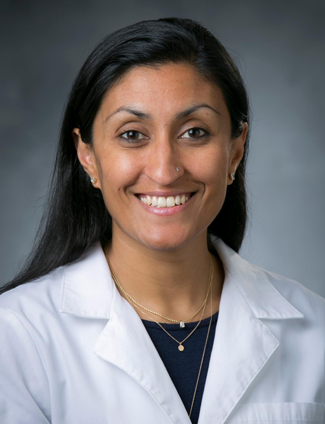
Shah and colleague Neha Pagidipati, MD, MPH, HS’13-’17, work together to try to understand why so few people with heart disease are taking cholesterol-lowering drugs that could help them. The investigators are working with six health systems to identify barriers that prevent more patients with heart disease from having their LDL tested, receiving a prescription, filling the prescription, or taking the medicine. The researchers are also developing strategies to overcome those barriers.
To generate the maximum benefit, the strategies have to be system-wide, scalable, and financially feasible, Shah said. “We’re trying to figure out how to make a health-system-wide impact to really move the needle at a population level,” he said.
At Duke, Shah and Pagidipati are running a clinical trial to evaluate the strategy of using a “care champion” to meet with patients while they are hospitalized and stay in touch after discharge. The care champion is responsible for nudging the patient or providers or both in the service of meeting the LDL goal.
To help educate patients and providers at Duke, Shah said, cholesterol reporting has changed on Duke MyChart. In the past, LDL was flagged as abnormal only above 190. That’s been changed to 100. There is also guidance at the bottom of the test result about desirable LDL levels, which will be updated according to the new guidelines.
“We’re trying to find ways to maximize awareness at the provider side and the patient side so we get to the common goal of improving everyone’s cardiovascular risk,” he said.
If so few patients with known heart disease are taking cholesterol-lowering drugs, one can imagine uptake is even lower among those who have high cholesterol but haven’t had a heart attack or stroke — yet.
“The problem with high cholesterol is that you don’t feel it,” Shah said. “It’s just circulating in your body until something happens. You want to prevent that something from happening.”
Many of Shah’s studies involve patients who have already had heart attacks or strokes, but he wants to expand his work to prevent the first heart attack not just subsequent ones.
“Proactive, not reactive,” Shah said. “That’s my motto in life.”