
In 2006, Duke University School of Medicine researchers, led by YT Chen, MD, PhD, professor emeritus of pediatrics, secured the Food and Drug Administration’s approval for a breakthrough enzyme replacement therapy called Myozyme to treat Pompe disease. Pompe disease is a glycogen storage disease, a rare, inherited metabolic disorder that causes glycogen to build up in a person’s cells. Myozyme was the first treatment option available for this devastating disease.
After Myozyme was released, Duke University founded the YT and Alice Chen Pediatric Genetics and Genomics Research Center. The Center has been led by Priya Kishnani, MD, who spearheaded clinical trials culminating in the approval of Myozyme. With various sources of funding – from royalties; federal, industrial, and foundational grants; and generous contributions from Alice and YT Chen, the Center focuses on basic, translational, and clinical research to better understand how single-gene genetic and metabolic disorders affect patients.
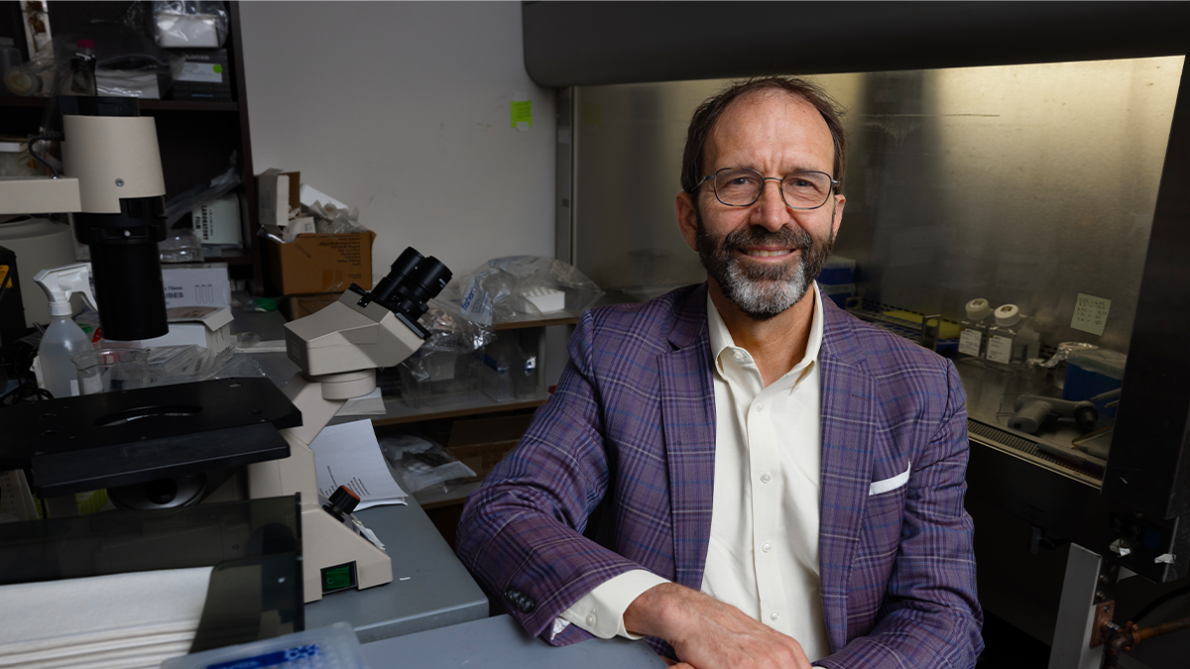
Dwight Koeberl, MD, PhD, professor of pediatrics, has been part of the Center since its inception. In the nearly two decades since, Koeberl has been able to rely on the Center’s resources as a foundation for his laboratory’s work on new therapies for glycogen storage diseases, work that has led to several clinical trials.
“The support, the environment, the team, and the greater resources at Duke have allowed us to go from experiments treating mice with Pompe disease to navigating all the steps necessary to be able to start a clinical trial,” Koeberl said,
The Chen Center and university resources like the Office of Regulatory Affairs and Quality enhance the ability of researchers at Duke to conduct trials of new potential therapies. “Not all universities have such resources,” Koeberl said, “so being here in the Chen Center has created unique opportunities.”
Koeberl’s research focuses on Pompe disease and glycogen storage disorder type Ia, but there are 15 glycogen storage diseases, including Pompe disease. “My colleagues are doing research in the laboratory and with patients to better understand these diseases and to develop new treatments for multiple glycogen storage diseases,” Koeberl said.
From Enzyme Replacement to Gene Therapy: Progress in Pompe Disease Treatment
People with Pompe disease lack an enzyme called acid alpha-glucosidase (GAA), which causes glycogen to build up in the patients’ cells in a special compartment called the lysosome. GAA normally breaks down glycogen in the lysosomes into glucose, which is the primary energy source for cells. Without GAA, glycogen cannot be broken down, so it accumulates and causes severe muscle damage. This muscle damage leads to weakness and to early death from impaired blood circulation and breathing. It is fatal without treatment.
Before Myozyme, no treatment options existed for patients with Pompe disease, and families were told to enjoy their remaining time because nothing more could be done. Life expectancy for an infant diagnosed with Pompe disease was less than two years.
One of Koeberl’s biggest milestones in the Chen Center was filing for an investigational new drug (IND) application with the FDA for gene therapy for Pompe disease. “It was a ten-year process from the initial concept to having that IND to be able to begin a clinical trial,” he said.
He has now filed several INDs for Pompe disease with the help of the Chen Center team and the Office of Regulatory Affairs and Quality. He has also initiated four clinical trials for Pompe disease: one using clenbuterol, two utlizing extended-release albuterol, and one employing an AAV8 vector-mediated gene therapy. “The gene therapy study is ongoing and could lead to a new treatment for many patients with Pompe disease,” he said. “It could improve upon the enzyme replacement therapy that we have now.”
With enzyme replacement therapy, patients need to visit the clinic every 1-2 weeks to receive an infusion of the enzyme. “But with gene therapy,” Koeberl said, “a single dose should continue to make GAA long-term and therefore have long-term benefits.”
His first clinical trial suggested just that – long-term effects and benefits. It is now licensed to AskBio, a clinical-stage gene therapy company started in Chapel Hill. AskBio has partnered with Bayer to launch a clinical trial with the goal of obtaining FDA approval for gene therapy for Pompe disease.
Tackling GSD Ia with Precision Tools
Glycogen storage disorder type IA (GSD Ia) is an inherited disorder that affects the liver. “A mutation in a specific gene prevents the body from being able to break down glycogen to glucose in the liver and kidneys,” he said, “which causes low blood sugar, enlarged liver and kidneys, growth failure, and high levels of lipids and uric acid in the blood.”
While it is not part of newborn screening, GSD Ia is diagnosed in infancy. A baby with GSD Ia who goes a few hours without eating will have a severe drop in their blood glucose. “So, when they sleep through the night for the first time,” Koeberl said, “they will wake up with a seizure from severe hypoglycemia.”
Koeberl recently published research in which his team used a genetic tool called CRISPR/Cas9 to treat GSD Ia in mice by inserting a normal gene in their liver DNA.
Inserting a gene with CRISPR/Cas9 is known as genome editing. Genome editing is especially effective in GSD Ia, especially in combination with bezafibrate, a drug used to improve liver cells in GSD Ia. Dr. Koeberl plans to continue developing this method with the goal of initiating a clinical trial.
Future Directions
The next goal on Koeberl’s list is an ambitious one: moving beyond traditional gene therapy and into the next frontier—genome editing—to treat glycogen storage diseases.
Today’s gene therapies rely on modified viruses called AAV vectors, to deliver healthy genes into cells. It’s a remarkable tool, but not a permanent one. The AAVs eventually fade, meaning patients—especially growing children—may need multiple doses over time. “The AAV vector is going to be lost from dividing cells as the young child grows, and currently we can only give one gene therapy with AAV,” Koeberl explained.
Because of this, AAV-based treatments tend to be more effective once a child is older and past the phase of rapid growth. “A clinical trial of gene therapy for GSD Ia enrolled kids as young as eight and have seen lasting results at that age,” Koeberl said.
Still, timing is everything. For GSD Ia, diagnosis often happens in infancy, and newborn screening now includes testing for Pompe disease. The earlier the treatment, the better the outcome. Koeberl’s long-term goal is clear: a therapy that works from the very start—and continues to work for life.
That’s where genome editing comes in.
Unlike conventional gene therapy, which introduces a new copy of a gene, genome editing can precisely rewrite the DNA itself—adding, deleting, or replacing genetic material at specific sites in the edited cells. Because the change is permanent, every new daughter cell carries the correction forward. In theory, it’s a one-time treatment that could last a lifetime, no matter the patient’s age.
For patients diagnosed with Pompe disease as infants, that permanence could be transformative. While enzyme replacement therapy is effective, it demands constant upkeep: hours-long IV infusions every week or two. Missing even a single session can cause symptoms to return. “With genome editing,” Koeberl said, “a single dose should continue to make the enzyme long-term and have continuing benefits.”
Each experiment and trial Koeberl completes is one step closer to that vision—a durable, perhaps once-in-a-lifetime treatment for diseases like Pompe and GSD Ia.
Photo by Mark Dolejs, Senior Visual Storyteller