
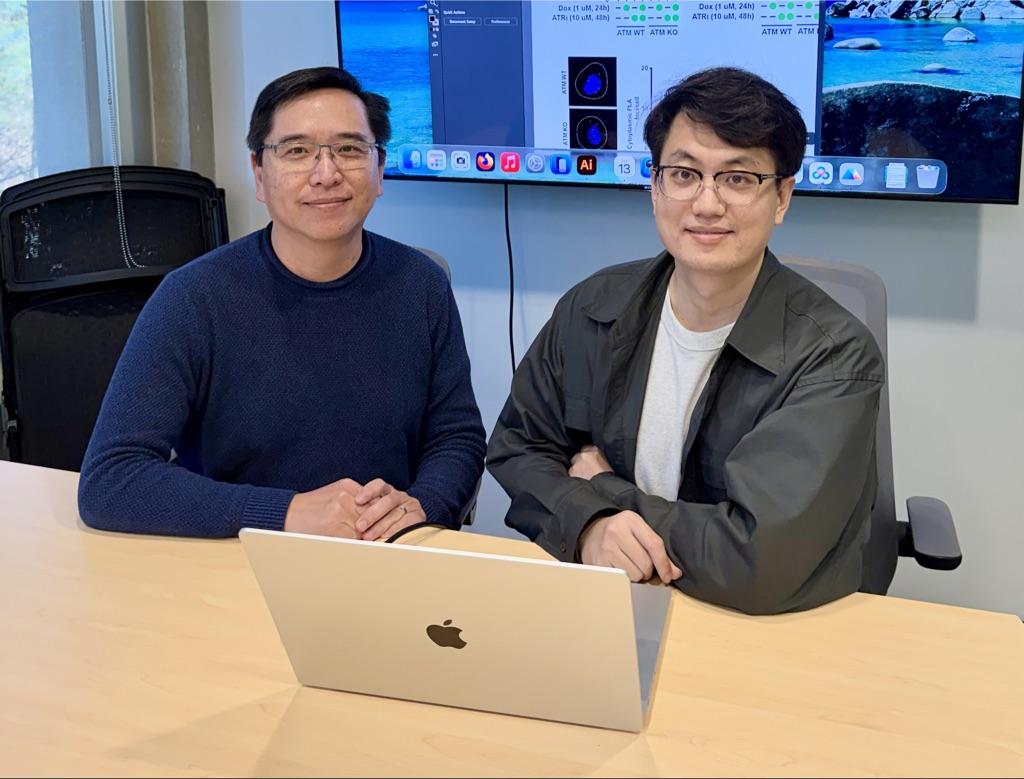
A study from cancer biologists at Duke University School of Medicine suggests a new way to predict which patients are most likely to benefit from a promising class of experimental cancer drugs called ATR inhibitors.
In clinical trials, these therapies have shown efficacy in a subset of tumors with mutations in the DNA-repair protein ATM kinase. But why ATR inhibitors work in some but not all ATM-mutant tumors has been unclear.
Researchers led by Lee Zou, PhD, found that levels of another protein, cGAS, strongly influence how well ATR inhibitors work. When cGAS was removed from ATM-deficient cancer cells, they became less sensitive to ATR inhibitors, suggesting that measuring cGAS levels could help identify patients most likely to respond to the drugs.
In addition, the study, published in Nature Cell Biology, uncovers a previously unknown role for ATM in protecting cells as they copy their DNA.
Normally, cGAS acts as an “alarm system.” When cGAS detects DNA where it shouldn’t be, it activates interferons — immune signals that warn the body something is wrong inside the cell.
When cGAS was removed from ATM-deficient cancer cells, they became less sensitive to ATR inhibitors, suggesting that measuring cGAS levels could help identify patients most likely to respond to the drugs.
The team showed that ATM keeps this alarm from being triggered at the wrong time. By restraining cGAS, ATM maintains smooth DNA replication, Zou said.
“ATM removes cGAS from chromatin and restricts the formation of DNA fragments that activate cGAS,” Zou said. “In the absence of ATM, replication forks slow down, DNA becomes fragmented, and these fragments trigger an aberrant interferon response.”
Postdoctoral associate Yunhao Song, PhD, did much of the hand-on work in mouse and human cancer cell lines that revealed this unexpected balancing system.
“The impact of cGas in slowing replication forks is totally surprising. Our finding may completely change how people think about the impact of cGAS in cells,” Zou said.
Because ATM mutations are common in breast, prostate, colorectal, pancreatic, and other cancers, the work offers new insight into how DNA damage and immune signaling become intertwined in cancer, and how that interaction could be exploited to better target emerging therapies.
Other Duke authors: Li Lan, PhD, Xiaojuan Ran, PhD, and Yu Xu, PhD.
Funding: the National Institutes of Health, Bristol Myers Squibb.