

Age-related osteoarthritis (OA) occurs when the articular cartilage that protects and lubricates our joints wears down and bones start to rub together, often causing pain, stiffness, swelling, or weakness in the hands, knees, hips, or other joints. It is very common, and it usually makes itself known at around the age of 50-60. Although not everybody develops OA, most of us do: up to 80% of people over 55 have it, although a fairly sizable percentage experience only very mild symptoms.
OA currently has no cure; most treatments focus on managing symptoms through medication, physical therapy, supportive devices, and sometimes surgery.
Duke researchers are looking for a better way, by harnessing the body’s own mechanisms of tissue growth and repair. One such effort seeks to tap the process by which joints form in the first place.
As a fetus develops, tissue known as mesenchymal tissue forms and eventually differentiates into cartilage at the sites where joints will grow. Most cartilage in turn gradually becomes bone, in a process that continues until young adulthood. Some cartilage, however, remains as the articular cartilage in our joints, where it protects our bones and facilitates movement — until it doesn’t anymore, and we develop OA.
What if scientists could induce the body to reactivate the process of articular cartilage formation to generate fresh new tissues to replace worn-out joint tissues affected by OA?
That is the goal of a bold effort by Duke researchers, in partnership with UCLA Health and Boston Children’s Hospital. This project is funded by the Advanced Research Projects Agency for Health (ARPA-H) Novel Innovations for Tissue Regeneration in Osteoarthritis (NITRO) program, which aims to develop the first-ever techniques to regenerate joint tissues. NITRO is led by ARPA-H Program Manager Dr. Ross Uhrich.
“Is there a way you could make the joint grow back and actually cure osteoarthritis, rather than just slow its progression?” said Benjamin Alman, MD, chair of the Department of Orthopaedic Surgery and Duke’s NITRO project lead.
“If you can activate the signaling pathways that generate articular cartilage during development, you could rejuvenate your articular cartilage and make it behave like you’re 20, 30, 40 years younger and regrow over time.”
The ultimate goal is to develop a low-cost injectable therapy that promotes joint tissue regeneration. Early studies in animal models have yielded promising results, and the team is now focusing on gathering the data required by the U.S. Food & Drug Administration to support approval for first-in-human clinical trials.
“If successful, this approach could fundamentally change how we treat osteoarthritis — moving beyond symptom management and toward actually restoring joint tissue and improving quality of life for millions,” Alman said.
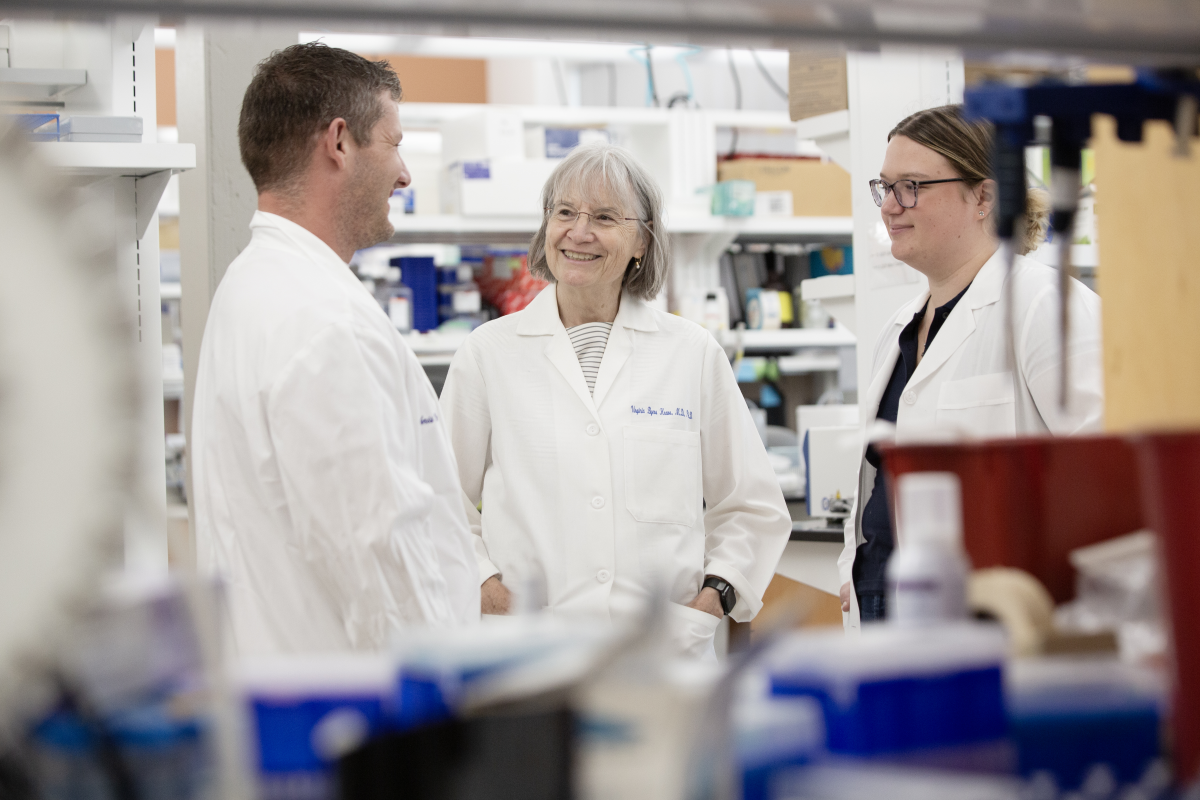
Recent research by other Duke scientists has found evidence that certain joint cartilage exhibits a surprising degree of innate regenerative capacity. They are working now to develop approaches to harness and optimize this ability.
Virginia Byers Kraus, MD, PhD, professor in the departments of Medicine, Pathology, and Orthopaedic Surgery, has shown that human ankle cartilage has the ability to self-repair. Kraus identified small RNA (smRNA) molecules that regulate this regenerative process — molecules that are identical to the ones that enable zebrafish and salamanders to regrow severed limbs and other lost tissues.
In humans, Kraus found, these smRNAs are abundant in ankles, intermediate in knees, and scarce in hips — likely one reason why ankles are less prone to osteoarthritis than other joints.
The task now is to learn how to optimize this innate ability and extend it to the areas that are most likely to develop OA.
“Ankle cartilage represents a regenerative environment and could serve as a template for enhancing cartilage repair in less regenerative joints such as knees and hips,” Kraus said.
Kraus has also developed a blood test that identifies biomarkers that successfully predict OA up to eight years before the disease shows up on x-rays or symptomatically.
“Early-stage osteoarthritis could provide a window of opportunity in which to arrest the disease process and restore joint health,” she said.
Any successful therapy to defeat OA could produce benefits far beyond just joint health. OA plays an important role in overall health, at least in part because OA often limits the physical activity that is so essential to good health, especially as we age. People with OA, for example, are much more likely than others to develop heart disease.
“Research suggests that if you get rid of osteoarthritis, you have a significantly lower risk of other medical conditions, for instance major cardiovascular or cerebrovascular events,” Alman said. “I tell medical students that if you really want to help the heart, one way is to go into orthopaedics and help get rid of osteoarthritis.”
This research was, in part, funded by the Advanced Research Projects Agency for Health (ARPA-H).
(The views and conclusions contained in this document are those of the authors and should not be interpreted as representing the official policies, either expressed or implied, of the United States Government.)
This article first appeared in the Spring 2026 print edition of Magnify Magazine.