
A new study in Nature reveals that one of the body’s most important receptor families signals through liquid-like protein clusters — an unexpected mechanism that could open new avenues for drug development.
Researchers at Duke University School of Medicine found that G protein-coupled receptors (GPCRs) — targets of roughly one-third of FDA-approved drugs — signal through dew-like droplets called biomolecular condensates, formed by β‑arrestin proteins.
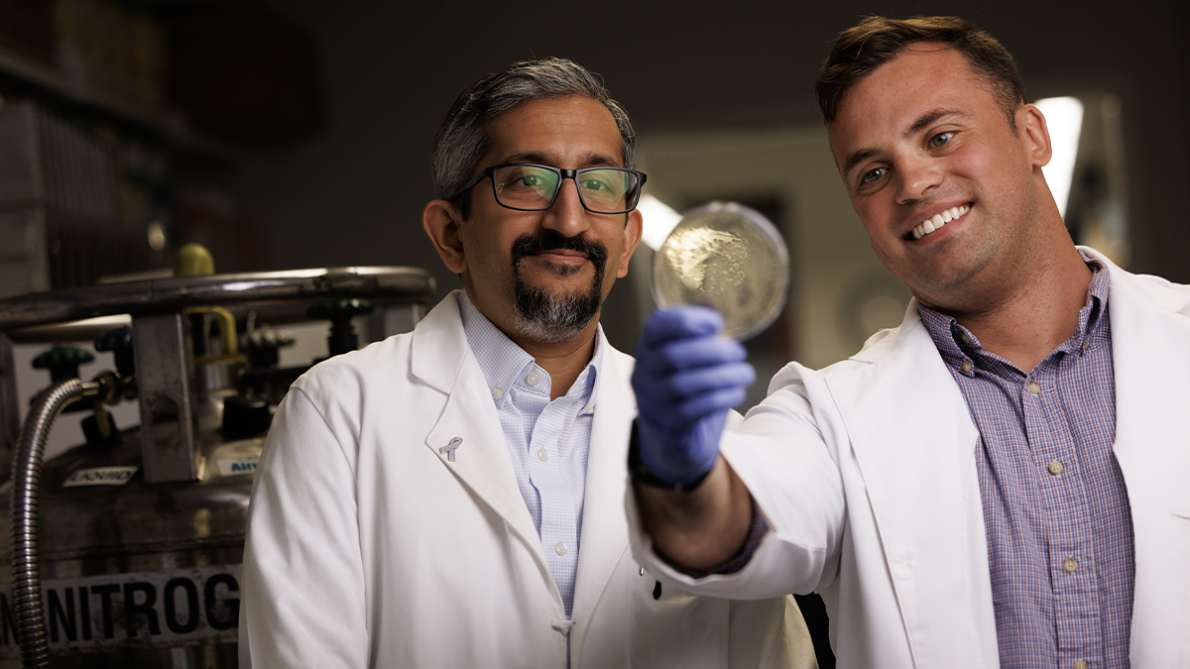
“Our work shows that these receptors that essentially regulate every aspect of physiology signal using a way that we didn’t appreciate before,” said Sudarshan Rajagopal, MD, PhD, associate professor of medicine and senior author of the study. “That’s important because it’s potentially druggable; it suggests that there might be different ways to target GPCR signaling that take advantage of their use of these condensates.”
β‑arrestins have long been known to regulate GPCR activity and are best known for their role in stopping their signaling. But a longstanding puzzle in the field has been how just two β‑arrestin proteins regulate nearly 700 GPCRs in the human body.
For decades, GPCR signaling has largely been understood as a one-to-one interaction: a receptor activates a single β‑arrestin, which then passes the signal along to the next molecule in a linear chain.
What if β‑arrestins weren’t just clustering, but assembling in a way that allowed them to communicate?
But that tidy model didn’t match what MD‑PhD student Preston Anderson had been seeing under the microscope. At levels normally found inside cells, β‑arrestins are known to form clusters inside cells. During a beach vacation to Kure Beach, as he watched clouds drift and merge across the sky, he began to wonder if β‑arrestins might do the same. What if they weren’t just clustering, but assembling in a way that allowed them to communicate?
That night, he drew a sketch proposing an experiment to test his idea. “When I sent it to Sudar, he basically said it wasn’t going to work. But Sudar is such a great mentor; he never says no. He'll always let you do the experiment,” Anderson said.
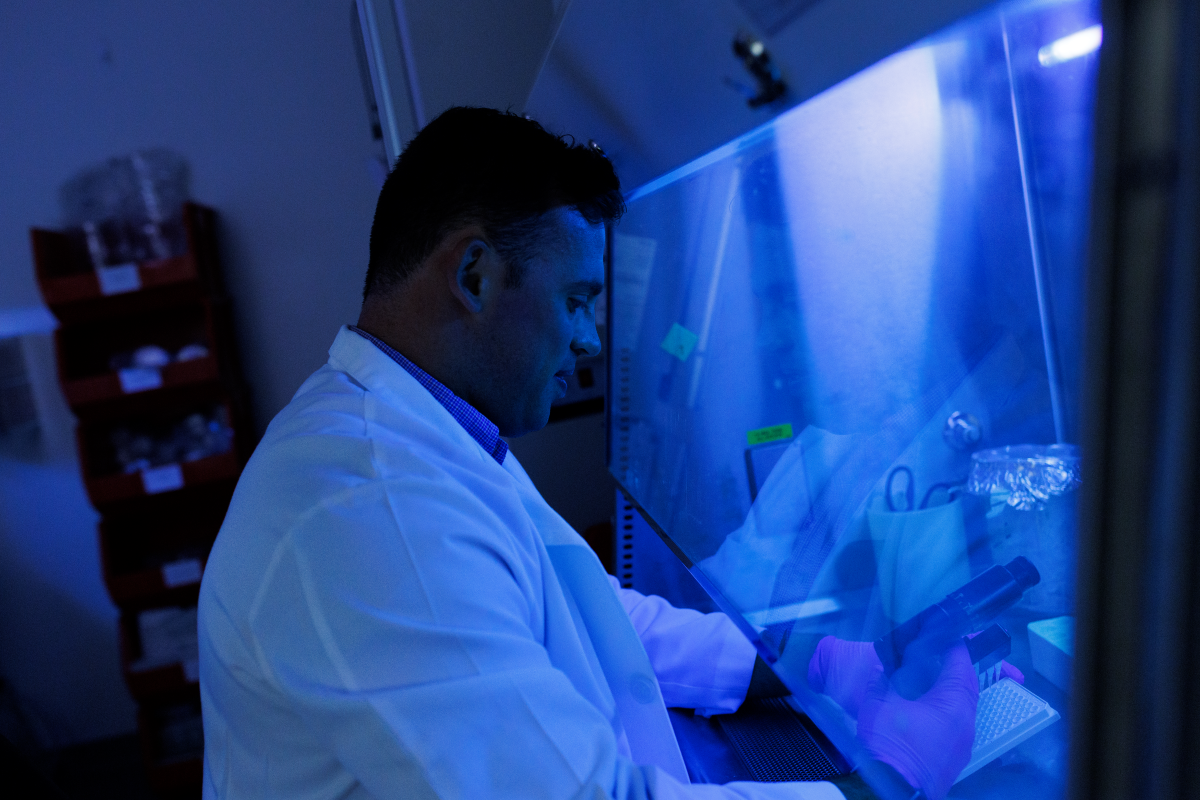
Back in the lab, Anderson attached two halves of a glowing protein to the tail ends of β‑arrestins to see whether they would light up when the proteins come together. When he ran the experiment, they did.
“When I saw it glowing, I thought, ‘We’re onto something,’” he said.
The work began to shift the view of β‑arrestins from individual actors to components of a larger, coordinated system.
“One part of our study shows that the way β-arrestins align and orient with one another influences how effectively they regulate receptor signaling,” Anderson said.
In addition to the split-protein test, over three years of work the team tested the idea with multiple approaches, including:
- Imaging to visualize β‑arrestin droplets both at baseline and near receptors in cells
- Using chemical and genetic tools to promote and disrupt clustering
- Functional assays which showed how those changes affect receptor signaling and internalization.
Together, these experiments showed that β‑arrestin clustering is not incidental — it directly influences how GPCRs function. When the scientists disrupted the condensates, GPCR signaling was disrupted.
Because condensates organize signaling in specific locations, they may offer new ways to more precisely control GPCR activity. That could ultimately allow drugs to target certain signaling pathways while avoiding others.
“It's a new model for understanding how this system works,” Rajagopal said. “It suggests we should start thinking about how to selectively target these condensates in the context of specific receptors.”
GPCRs are found throughout the body, and drugs that act on them are used to treat conditions ranging from shock to heart disease and asthma. Anderson said his interest in GPCR biology was shaped by his clinical training during the COVID‑19 pandemic, when he saw patients in shock treated with the same set of GPCR-targeting drugs — such as norepinephrine and vasopressin — that have changed little in decades.
The work builds on Duke’s long legacy in GPCR research, including the discoveries of Robert Lefkowitz, MD, which helped define how these receptors function and earned the 2012 Nobel Prize in Chemistry. The new findings point to a next chapter — one in which the spatial organization of signaling, becomes central to how scientists understand and target these critical systems.
Funding: The American Heart Association, the Mandel Foundation, and the National Institutes of Health.
Other Duke Authors: Adam Kaakati, Juliana Alfonso-DeSouza, Alejandra Patino, Andrew Ahn, Chanpreet Jassal, Samuel Liu, Biswaranjan Pani, Athmika Krishnan, Oscar Chen, Joseph Strawn, and Joshua C. Snyder.