
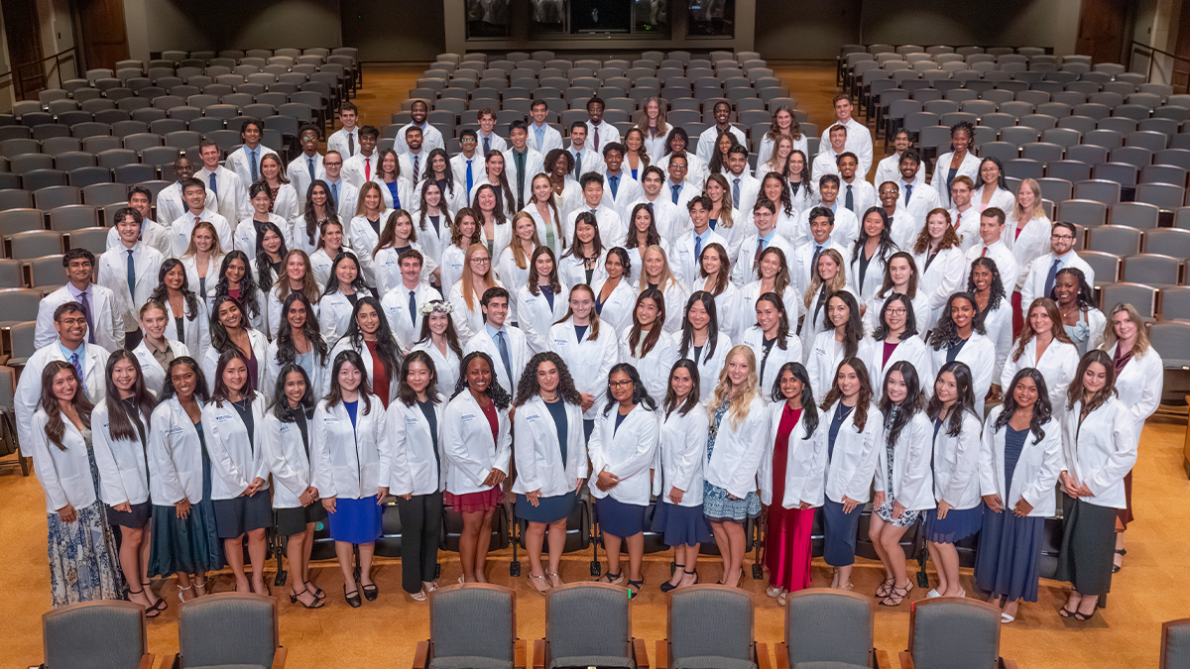
Wearing newly issued white coats and stethoscopes, 120 students joined Duke University School of Medicine's incoming class during a ceremony that marked their formal entry into the medical profession.
The annual White Coat Ceremony is widely recognized at medical schools across the country as a symbolic beginning to a career in medicine.
At Duke, the Aug. 7 event represented the moment when students are asked to embrace the responsibilities and values of caring for patients: respect, scientific integrity, and humility, said Joseph Jackson, Jr., MD, associate dean and director of the Office of Student Affairs who serves as advisory dean for the MD Program.
The coat serves as both a practical garment, he said, and a cloak of compassion.
"At some point you will obtain a longer coat as you continue in this transformation," he said. "We invite you to embrace this transition. Don't rush it and even rejoice that right now, your coat is short. Use this time to be less concerned with what you don’t know and approach the day with curiosity and gratitude."
For Aditee Narayan, MD, MPH, vice dean for medical education and health profession education, one of the most memorable parts of the day happened in the audience.
"I really loved talking with the families and loved ones," she said. "The amount of pride, the amount of love, and the amount of support that I could feel from the people in the room for our newest students was absolutely palpable."
She reminded students that reaching medical school required years of discipline and sacrifice.
"You have worked incredibly hard to get here," Narayan said. "It took an enormous amount of drive and dedication and time and effort. We are here to celebrate that and acknowledge that and honor that."
The incoming class brings a wide range of experiences to Duke. Students ranging in age from 20 to 36, come from 57 undergraduate institutions and 21 states. Eleven already hold graduate degrees in fields including biomedical science, data science, public health, and epidemiology.
But on this day, their varied backgrounds gave way to a shared identity.
-
 “Donning humility and doffing pride,” Joseph Jackson, Jr., MD, uses the clinical concept to instruct students on the character traits they must adopt and discard.
 -
 At Duke School of Medicine’s White Coat Ceremony, students Max Slotnik and Sidney Searles (center) receive their coats from advisory deans Leonor Corsino, MD, MHS, (far left) and Aimee Chung, MD.
 -
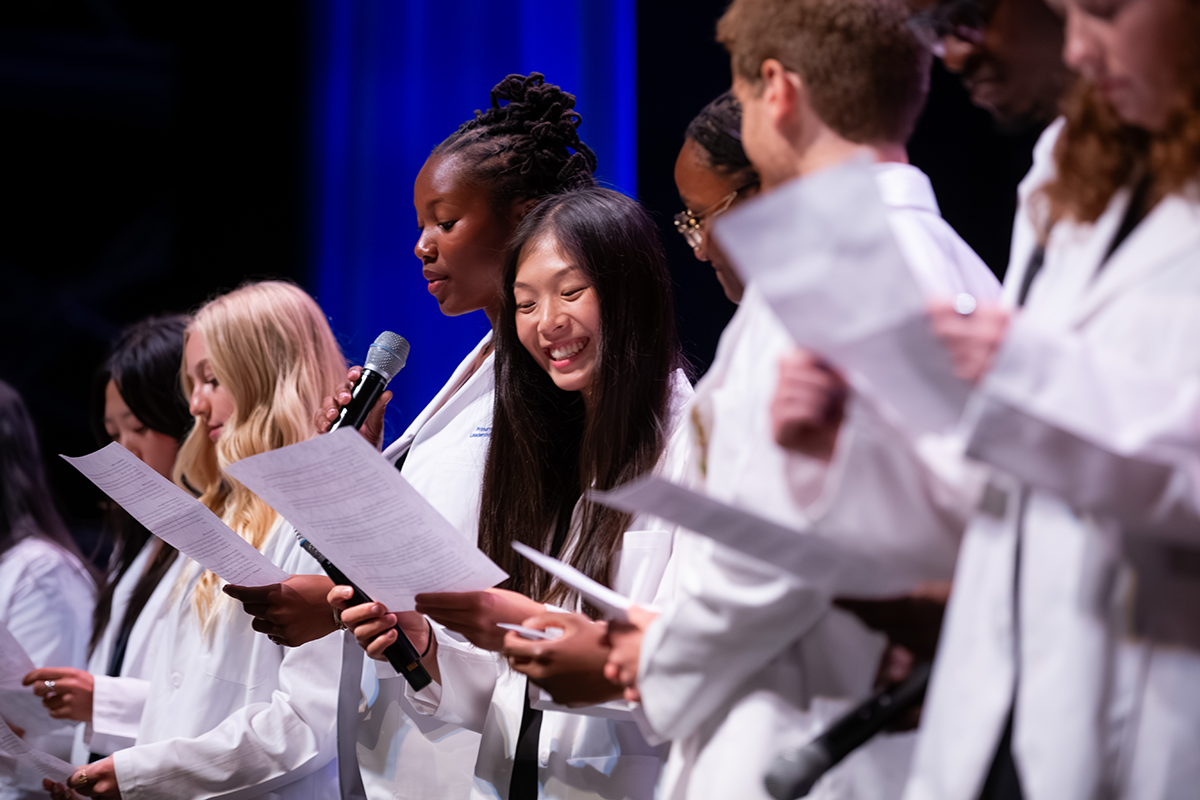 More than a coat, the White Coat Ceremony at Duke University School of Medicine includes a pledge by students to uphold ethics and respect for patients throughout their training.
 -
 Blake Long, MD, represented the Duke Medical Alumni Association which provided each student with a white coat embroidered with their name that included a note of encouragement from a Duke alumnus and donor.
 -
 The incoming class at Duke University School of Medicine with their advisory deans, Elizabeth Malinzak, MD; David Gordon, MD; Aimee Chung, MD; Joseph Jackson, MD; and Leonor Corsino, MD, MHS.
 -
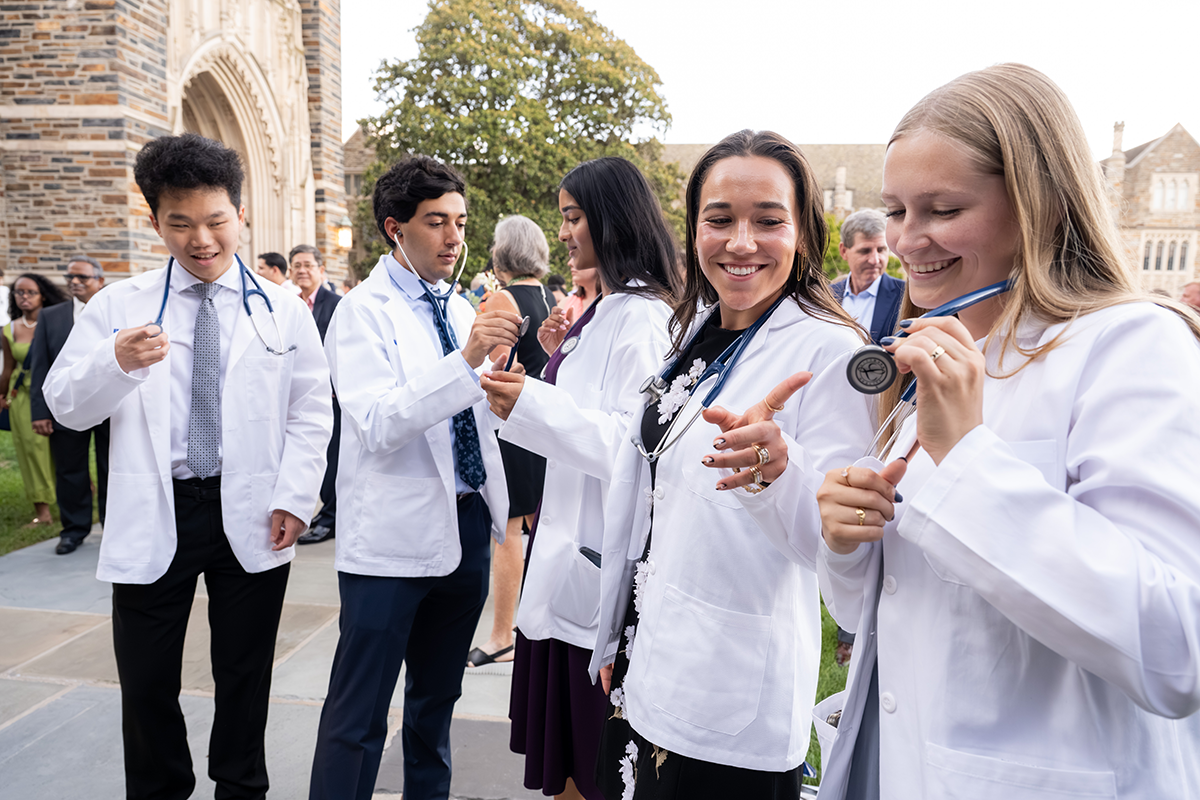 A fresh set of stethoscopes, a new white coat, and years of training ahead: members of Duke School of Medicine’s incoming class gather outside Page Auditorium.
 -
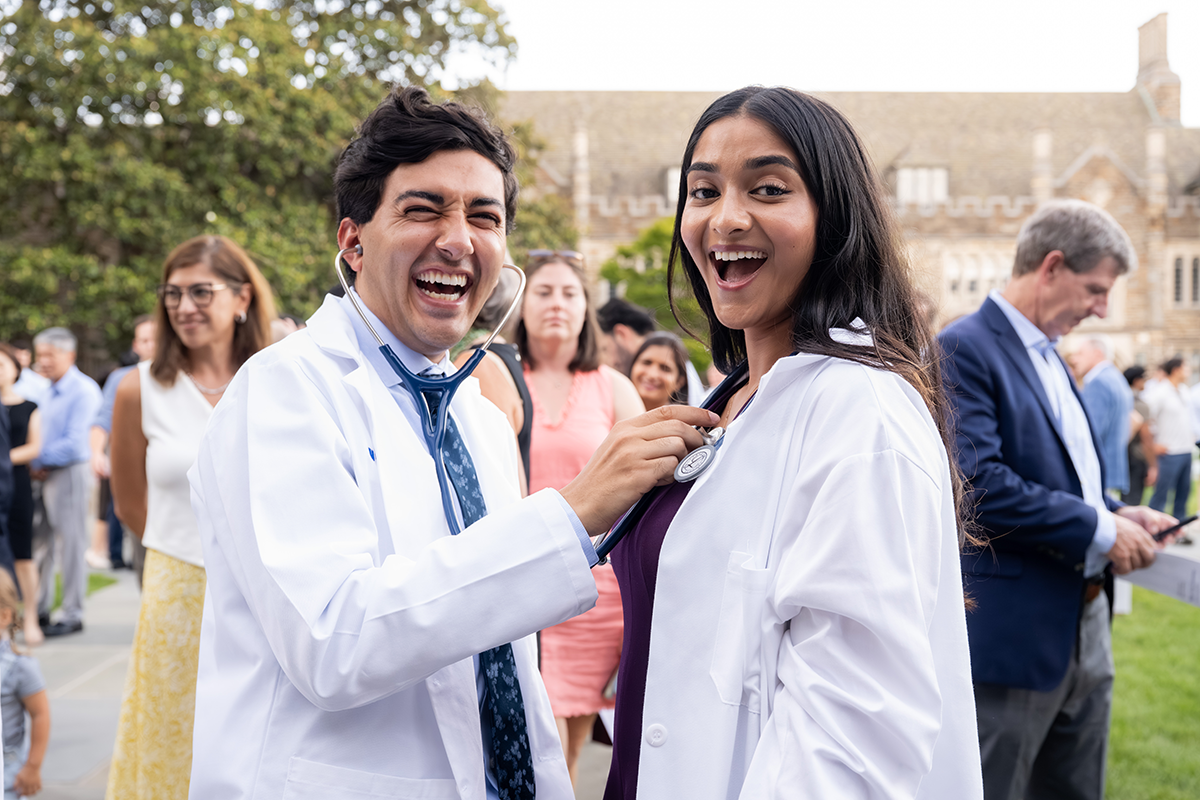 Duke University School of Medicine first-year medical students Dominic Maglione (left) and Divya Lobo test-drive new stethoscopes, a playful first step into the long, fascinating journey of becoming a physician.
Medical Alumni Support
That theme was echoed by Blake Long, MD, a Duke alumnus, physician entrepreneur and pediatric cardiologist who attended on behalf of the Duke Medical Alumni Association.
Speaking to students before they received their white coats, Long reflected on the symbolism of the garment that has long served as a visible marker of the medical profession.
“You may have noticed that I’m the only one not wearing a white coat,” he joked. After two decades in pediatric cardiology, he said, his current work in venture capital no longer requires one.
“But regardless of career path,” he told the students, “once you put on the white coat here today, you will never really take it off.”
The Duke Medical Alumni Association provides each student with a white coat embroidered with their name and the Duke School of Medicine logo, along with an engraved stethoscope. Inside each coat pocket is a note of encouragement from a Duke medical alumnus and donor.
Long described the gifts as symbols of a lifelong connection to the school and its graduates.
"Our alumni community is strong," he said. "We look forward to a lifelong connection as we warmly welcome you to the Duke family."
"You Belong Here"
If Long focused on the profession's enduring bonds, Julian T. Hertz, MD, assistant dean for clinical education and an emergency medicine physician, focused on its deeper purpose.
Standing before the new students, Hertz admitted that when he attended his own White Coat Ceremony as a Duke medical student, he felt out of place.
"I remember looking around at the other students who were just so cool and polished and confident," he recalled. "And I was thinking to myself, I do not belong here."
Years later, he learned many of his classmates had felt the same way.
"So, if any of you are feeling a little bit out of place," he said, "I want to reassure you: you belong here."
The years ahead will bring rigorous coursework, long hours and difficult challenges. But they will also bring the privilege of caring for patients at some of the most consequential moments of their lives, he said.
"Starting today, you're part of that team," Hertz told the class. "Welcome to a profession that's deeply fulfilling. Welcome to a community that's honored to support you. And welcome to a journey that I hope you find rewarding more than you could imagine."