
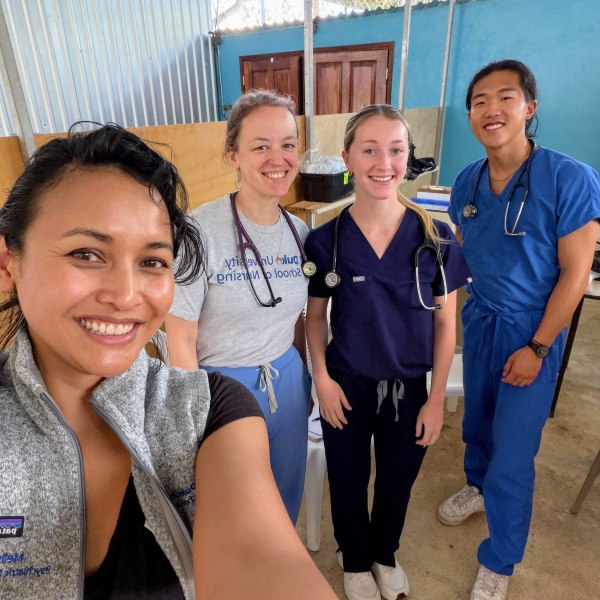
The patient's wound had been open for three years. In a rural Honduran clinic with no operating room or specialist nearby, Duke University School of Nursing consultant Rosa Solorzano, MD, MPH, offered her team an option that made some do a double take: sugar.
"My co-workers, my peers, my team was looking at me like, are you out of your mind?" recalls Solorzano, who had seen the treatment work during years of rural practice in Colombia. The team cleaned the wound daily and packed it with sugar. Two weeks later, it had closed.
It's the kind of moment that doesn't happen in a Duke University lecture hall — and that's the point of Duke's Exploring Medicine in Honduras program, designed to teach good medicine without the usual tools, alongside a team that doesn't look like the one back home.
The program was started 26 years ago by Dennis Clements, MD, professor emeritus of pediatrics and global health at the Duke University School of Medicine, whose visionary leadership was instrumental in the establishment of the Duke Global Health Institute (DGHI), helped position Duke as a leader in health education, research, and community engagement.
Clements believed health professions students needed more than a clinical rotation to understand global health — they needed to live it, together. He worked with colleagues and partnered with Heifer International to build a clinic in Las Mercedes, Honduras that serves 12 surrounding villages in the Intibucá region.
Partnerships instead of mission trips
The program has since grown into a partnership housed at the Duke School of Nursing and co-directed by Solorzano and Mitch Heflin, MD, through the Duke Interprofessional Education Center, drawing medical, nursing, and physical therapy students into a single traveling team.
Each spring, a cohort of about 22 students and five faculty members — physicians, nurse practitioners, and a visiting dentist from the University of Rochester — spends 12 weeks preparing, covering likely illnesses, the ethics of short-term outreach, and the culture of the Maya communities they will serve.
Then comes 10 days of clinical outreach, partnering with nonprofit Heifer International to identify communities with both significant need and potential for lasting relationship.
It is the relationships that matters most, said Solorzano, consulting associate in the School of Nursing. The team has now returned three straight years to the community of El Naranjo.
"We never go to a place that we are not invited," she added. “They are very grateful that we come every year. We see how our little impact really made a big impact in their lives."
Teams over hierarchies
What sets the program apart, Solorzano noted, isn't just where it happens but how.
Students work in small interprofessional teams — a faculty clinical instructor paired with two or three students from different disciplines and language levels — and see patients as family units rather than individually on a ten-minute clock. Everyone rotates through intake, clinical visits, and the pharmacy, where students counsel patients on medications, often adapting instructions for those who can't read.
Medical Spanish instruction runs alongside clinical preparation, split between beginners learning survival vocabulary and advanced speakers refining medical terminology, but fluency isn't required. Students who don't speak Spanish still participate fully through their teammates.
Over ten days, the team sees roughly 100 patients a day, as many as 600 total, with dental care running in parallel — often students' first exposure to dentistry as part of primary care.
Professional titles fade into the background, Solorzano said: "At the end, we don't know who is a med student, who is nursing. Everybody's putting in their own effort and their own expertise."
Learning to think, not just diagnose
Without imaging or specialists on demand, students rely on physical exam skills and clinical reasoning that can get crowded out at a resource-rich hospital like Duke.
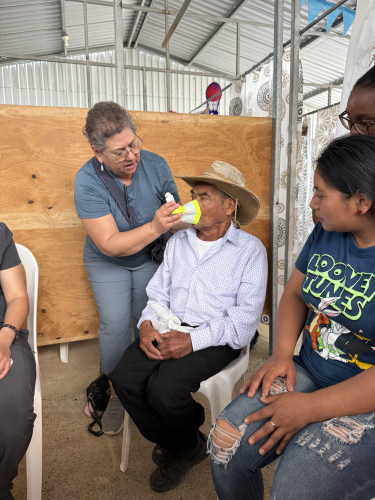
When one elderly man arrived with poorly controlled asthma and no inhaler in the budget, students spent nearly an hour building a makeshift spacer from a paper cup and sat with him until he could use it correctly.
"That's something we would never face here," said medical student Angelina Nasthas, who has family roots in Honduras. "We have no shortage of inhalers and spacers. But we were able to jerry-rig it."
One story stays with Solorzano: a 10-year-old boy arrived needing a tooth pulled, and the dentist noticed severe untreated psoriasis that had led to bullying. The team began treatment with what resources they had. Three days later, "he was a completely different boy," Solorzano said — no longer bullied.
Moments like that, she says, are what she hopes students carry with them long after the trip ends: "They find themselves. They find their strength, they find the compassion, they find how they can see medicine in a different lens," she added.
Student perspectives
Melissa Hem, a psychiatric mental health nurse practitioner student, shadowed general assessments before pulling aside patients showing signs of anxiety or depression.
For Hem, the journey provided an answer to a need she had been chasing since a service trip to Cambodia — her family's home country — a decade earlier. She has since taken a job in community mental health in a Los Angeles neighborhood with large Latino and Asian populations. Honduras helped sharpen her Spanish as well as her instincts.
"This trip really set a benchmark for me, and helped set the tone for the very beginning of my career,” Hem said.
One conversation has stayed with her: a 58-year-old woman, the sole income earner for her extended family, worried she couldn't keep everyone fed.
"My heart totally sank," she said. "I didn't want to diminish anything she'd said to me by coming from my privileged Western background."
With no psychiatric medications on hand beyond a mild antihistamine, Hem leaned on deep-breathing techniques and a referral built on the spot, connecting the woman's unemployed son with a job at a nearby coffee plantation.
"I left feeling like I hadn't done much," she added. "But what I can rely on is maybe the human connection."
Nasthas remembered a woman who traveled hours with dangerously high blood pressure and returned the next day for a recheck, her pressure normalized. "I remember feeling this joy just knowing she really cared about her health," she said.
Both students said the interdisciplinary structure changed how they see their own roles.
"Everyone's different scope of care, and how they approach the patient was eye-opening,” Nasthas said, pointing to lessons she carried into how she communicates with colleagues at home.
Hem agreed: "The cohesiveness of working in this interdisciplinary team, and how much we each respected each other's skills — that was probably the most impressive part."
For both, the trip confirmed their direction rather than changing it. Nasthas, who has family in Honduras without access to a hepatologist for their liver disease, said the experience strengthened her desire to treat underserved patients. She hopes to return regularly.
Hem called her experience a source of reassurance about the field itself: "Every single person on this trip has this immense ability to make something happen and make a change in the world. I was very honored to be around this group of people," she said.
An uncertain future without support
The program's growing reputation has earned a reputation among School of Nursing and School of Medicine leaders, who refer to it as the gold standard for global interprofessional education — has not solved one of its most practical problem: cost.
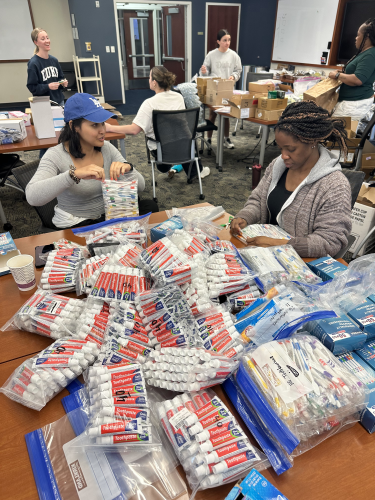
Donations play a role in the program to cover basic supplies like sunscreen and toothbrushes, for which Heflin expressed gratitude. But there is a direct cost for students that sometimes presents a big hurdle. Each student pays $3,500 to participate, a fee that a shrinking pool of scholarship funds can only partially offset.
"We would love to have the opportunity to not let anybody behind because they couldn't find the resources," said Solorzano, who hopes to establish a lasting scholarship fund or endowment so that financial need never determines who gets this experience and who does not.
For a program built on the idea that healthcare is strongest when no one is left out — not the patients in El Naranjo, and not the students learning to care for them — it seems a fitting ask, Solorzano said.