

When Max Bucklan opened an e-newsletter from the Duke Graduate School last March, his eyes landed on three words that “stopped me dead in my tracks,” he said. The three words? Biomedical video contest.
Bucklan is a second-year graduate student in the University Program in Genetics and Genomics, an interdisciplinary biomedical PhD program. He also works in the lab of Simon Gregory, PhD, the director of the Brain Tumor Omics Program in the Duke Department of Neurosurgery.
As an undergrad at Duke, Bucklan majored in biology with a minor in film. A biomedical video contest was “the perfect fusion of things,” he said.
The contest was sponsored by the Albert and Mary Lasker Foundation, a champion of biomedical research.
With the deadline only weeks away, Bucklan decided to draw from a medium he knew well – LEGO. He’d use the bricks and minifigs in a stop-motion video to explain his research in the lab on atypical teratoid rhabdoid tumors (ATRT), a rare pediatric brain tumor.
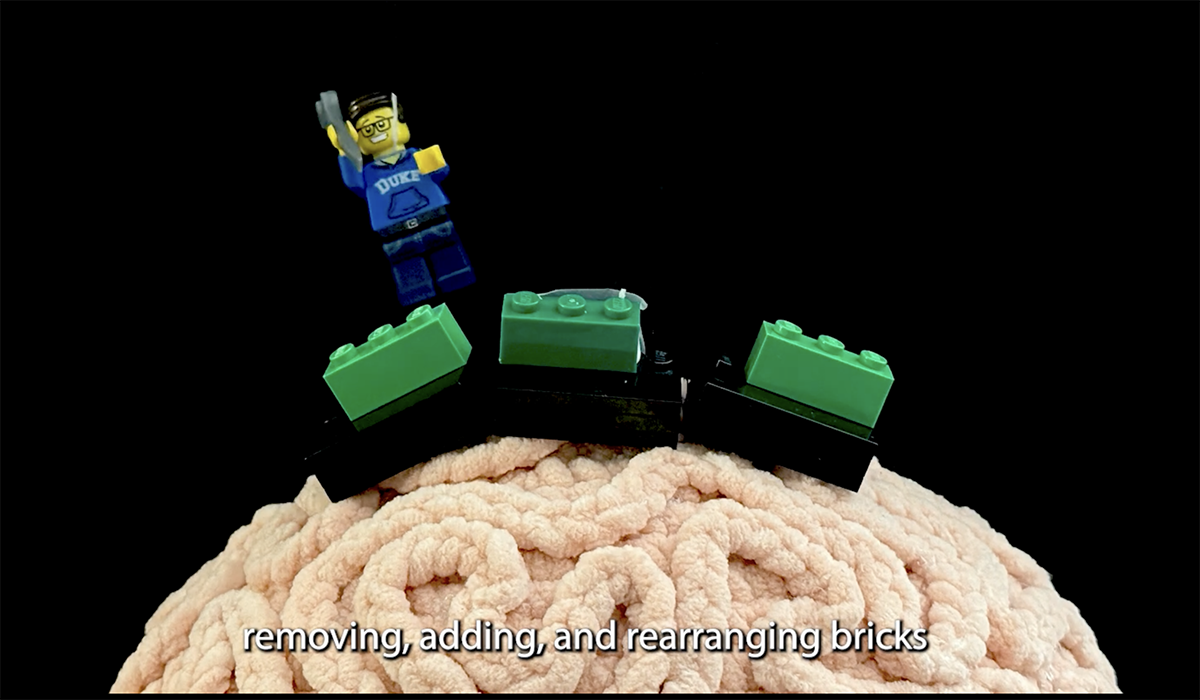
In particular, he focuses on alternative splicing -- a molecular phenomenon where the products of genes are assembled differently in cells, influencing cellular behavior. The lab uses single-cell long-read RNA sequencing, a cutting-edge technology, to generate an “isosome”-- a comprehensive map of all RNA isoforms at unprecedented resolution. In Gregory’s lab, the technology is used in the study of brain tumors, Alzheimer’s disease, and multiple sclerosis, with the goal of identifying novel drug targets to improve the treatment for each condition. “The work has the potential for broad impact on health and disease,” said Gregory.
The brick-based, alternative splicing video built on Bucklan’s earlier success with a birthday party presentation where he used memes and analogies to explain his research to non-scientific friends. “I felt that using physical props to explain complex molecular biology concepts could make science more accessible to a general audience,” he said.
When he received notice that he had (of course) won the contest, no one was prouder than his mentor. “Max’s done an amazing job intersecting art with the communication of science,” said Gregory, who is the Margaret Harris and David Silverman Distinguished Professor. “The novelty of the way he’s characterizing a devastating pediatric disease makes the work easier to relate to.”
The award included an invitation to the ceremony in New York City in September 2026, publication in the Journal of Clinical Investigation, and a $5,000 award for educational expenses.