
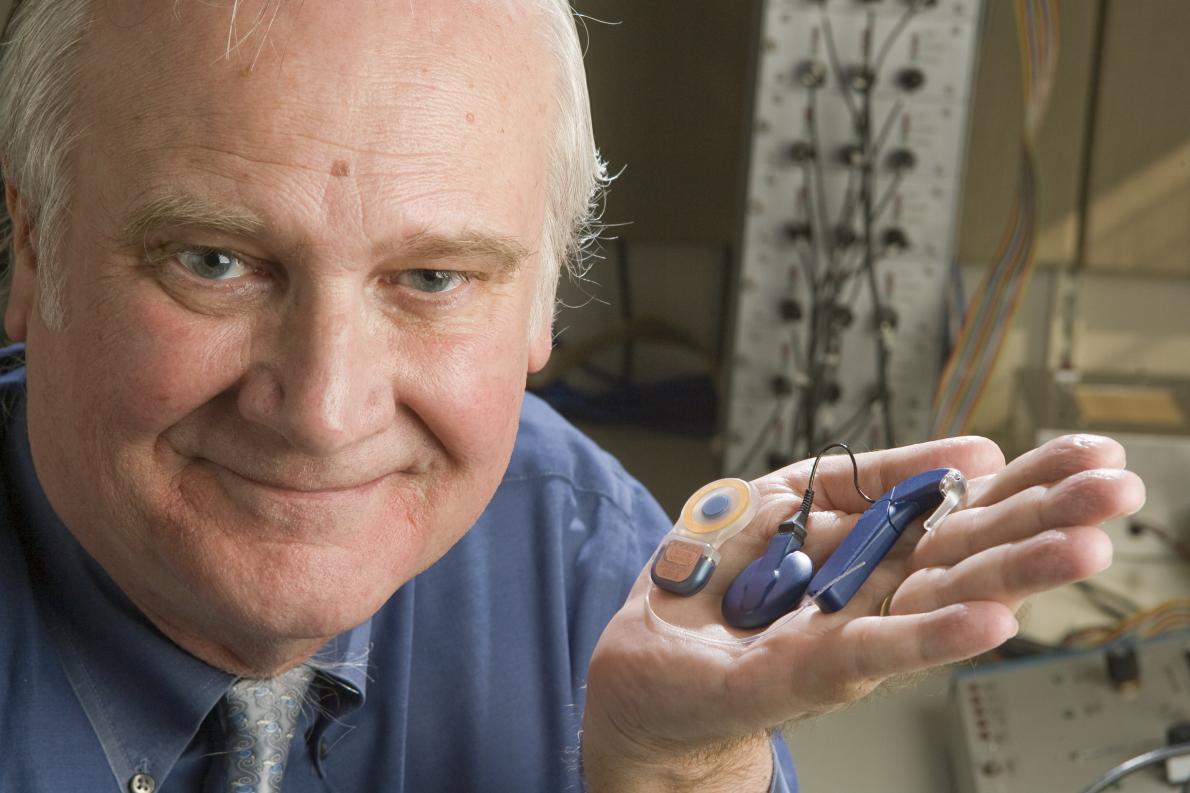
Duke University's Blake Wilson, PhD, D.Sc, D.Eng., who contributed to the development of cochlear implants that help people hear, has been awarded the 2026 Queen Elizabeth Prize for Engineering (QEPrize) for the design and development of modern neural interfaces that restore human function.
Wilson is among nine engineers named 2026 Laureates. Their achievements enable technology to interact directly with the brain and nervous system to restore abilities such as hearing, movement, and communication for people affected by sensory loss, paralysis, and neurological disease.
“I am overjoyed to receive the 2026 Queen Elizabeth Prize for Engineering alongside my fellow Laureates,” said Wilson, director of the Duke Hearing Center and an adjunct professor in the Department of Head and Neck Surgery & Communication Sciences at Duke University Medical School.
“The QEPrize represents the highest recognition in engineering, celebrating achievements that span the full breadth of the field. I am delighted to be among the 2026 Laureates, all of whom I admire greatly.”
Wilson has appointments with the Duke Pratt School of Engineering and is an affiliate of the Duke Global Health Institute.
“Congratulations to Blake Wilson on this honor, which recognizes not only his extraordinary engineering achievements but also his passionate commitment to research that advances human health and improves lives,” said Alec D. Gallimore, PhD, provost of Duke University and a distinguished professor in the Thomas Lord Department of Mechanical Engineering & Materials Science in the Pratt School of Engineering. “Duke is immensely proud to be Dr. Wilson’s alma mater and academic home for over 40 years.”
Modern neural interfaces encompass a wide range of technologies that connect engineered systems with the nervous system to restore function.
Among the most established of these are cochlear implants, which convert sound into electrical signals that stimulate the auditory nerve, enabling people who are severely to profoundly deaf to regain functional hearing.
Wilson is honored for his collective contributions to the development of cochlear implants, including advances in electrical stimulation strategies, multi-channel systems, device miniaturization, and sound processing. Together these discoveries transformed cochlear implants from experimental devices into reliable neural prostheses now used by over one million people worldwide.
Wilson, a member of the National Academy of Engineering, has received many other high honors including the 2013 Lasker-DeBakey Clinical Medical Research Award, the 2015 Fritz J. and Dolores H. Russ Prize, and the 2024 IEEE Medal for Innovations in Healthcare Technology.
“Dr. Wilson’s ingenuity is matched by a personal dedication to reducing the burden of hearing disability worldwide,” said Howard Francis, MD, chair of the Department of Head and Neck Surgery & Communication Sciences.
Wilson leads the Lancet Commission on Hearing Loss, a multidisciplinary group of experts focused on reducing the global burden of hearing loss and expanding access to effective hearing care.
The QEPrize — now in its 13th year — honors engineers whose innovations have delivered profound benefits to society. Lord Vallance, chair of the Queen Elizabeth Prize for Engineering Foundation, formally announced the 2026 Laureates at the Science Museum of London.
The Laureates will be formally honored at a QEPrize Presentation Ceremony to be held at a later date and hosted by King Charles III.