

Four physician-scientists at Duke University School of Medicine have been recognized with prestigious 2026 early-career awards from the American Society of Clinical Investigation (ASCI), honoring their exceptional contributions to biomedical research and patient care.
One Duke faculty member won an ASCI Young Physician-Scientist Award, which recognizes physician-scientists who are early in their first faculty appointment and have made notable achievements in their research:
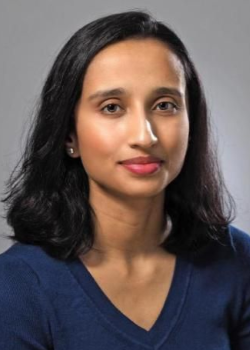
Deepshikha Ashana, MD, MBA, MS, assistant professor in Pulmonary, Allergy and Critical Care, is a pulmonary and critical care medicine physician and health services researcher in the Department of Medicine.
Her research program seeks to mitigate inequities in critical care medicine, with current foci in: (1) intensive care unit clinician communication and shared medical decision-making with Black patients and families; (2) psychological trauma associated with critical care (i.e., trauma-informed care); and (3) reproductive health policy and outcomes of pregnant women with serious illnesses. She has a strong track record of extramural funding, high-impact publications, and mentorship.
Three Duke investigators were honored with ASCI Emerging-Generation Awards, which recognize post-MD, pre-faculty appointment physician-scientists who are meaningfully engaged in immersive research:

Sonali J. Bracken, MD, PhD, is a medical instructor in the Division of Rheumatology and Immunology in the Department of Medicine. Her PhD research, supported by an NIH F30 award, focused on immune tolerance mechanisms in a house dust mite model of asthma. Following her MD/PhD training, Bracken entered the Internal Medicine residency program and R38 research training pathway at Duke University. She then completed clinical and research fellowships in rheumatology at Duke before joining the faculty.
Bracken’s clinical specialization is in systemic sclerosis, and her work with these patients has shaped her translational research interests. Her research, currently funded through an NIH K38 award, focuses on B cell-fibroblast crosstalk that promotes autoimmunity. The goal of her work is to develop safer and more precise B cell-targeted therapies for autoimmune diseases. In addition to her research, Bracken serves on the American College of Rheumatology Committee on Research and as a sub-investigator on multiple scleroderma trials and registries. In 2024, she was honored with the American College of Rheumatology Distinguished Fellow Award.
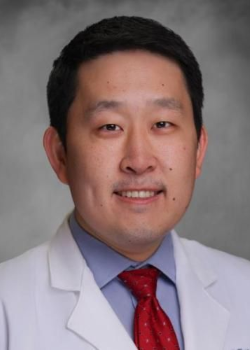
Mark S. Chen, MD, PhD, is a radiation oncology resident. He earned his MD and PhD in molecular cancer biology in the Duke Medical Scientist Training Program. For his PhD work, Dr. Chen earned an NIH Ruth L. Kirschstein NRSA F30 Fellowship Award from the National Cancer Institute (NCI) and a Young Investigator Award from the Connective Tissue Oncology Society.
Following his MD/PhD training, Chen completed a transitional year internship and joined the Radiation Oncology Research Scholar Physician Scientist Training Program at Duke. He was also inducted as a B. Leonard Holman Pathway fellow through the American Board of Radiology. In his third year of residency, he joined the laboratory of Ashutosh Chilkoti, PhD, in the Pratt School of Engineering, where he is using protein engineering of IDPs to develop novel molecular tools to study radiation and cancer biology. Chen has received several awards, including the NIH R38 StARR Award through the NCI and the ASTRO Residents/Fellows Seed Grant. His long-term career goal is to lead an independent laboratory focused on solving normal tissue toxicity to advance radiation oncology.
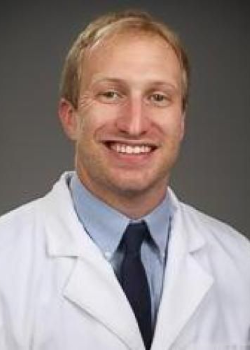
Ryne Ramaker, MD, PhD, is a hematology-oncology fellow enrolled in the Physician Scientist Training Program (PSTP). He completed an MD/PhD through a joint program with the University of Alabama at Birmingham’s Medical Scientist Training Program and the HudsonAlpha Institute for Biotechnology.
In Duke’s PSTP, Ramaker has taken an active role in Duke’s Molecular Tumor Board and led an initiative to expand expert clinical sequencing review to rural community oncology clinics across North Carolina. He is also developing novel methods for error-corrected sequencing and rare mutation detection. His initial work developing a sensitive approach to circulating tumor DNA detection for pancreas cancer patients was awarded a Hopper Belmont Inspiration Award and Duke Office of Physician Scientist Development (OPSD) Technician Support Award. Future directions of Ramaker's work include application of novel sequencing methods to better characterize what factors influence the initial mutations that lead to tumor formation and early clinical detection of pancreas tumor ctDNA when curative treatment is feasible.