
SoM Faculty Elected New Members of ASCI and AAP
Five School of Medicine faculty members were elected to the ASCI and AAP in April. Membership in these two organizations is a distinction recognizing excellence and outstanding achievement:

Duke Breast Cancer Expert Named One of TIME’s 100 Most Influential People for 2016
Shelley Hwang, M.D., chief of breast surgery at the Duke Cancer Institute, has been named one of TIME’s 100 most influential people for 2016 as a pioneer in her field.
One of the world’s foremost experts in early-stage breast cancers, Hwang has become an international leader calling for research to guide treatment for ductal carcinoma in situ (DCIS), in which abnormal cells are detected in the lining of a milk duct, but haven’t spread to other tissues.
School of Medicine Employees Receive Presidential Awards
The Presidential Award, one of Duke’s highest honors, is given to staff and faculty for outstanding job performance and distinctive contributions within the past calendar year. School of Medicine Recipients are:
Lakeshia “Kiwi” Whitted
Staff specialist, Office of Curricular Affairs
School of Medicine
Clerical/Office Support
Statement from Duke University Leaders Regarding HB2
Duke University is committed to fostering an open, welcoming, inclusive community that respects each individual. We remain steadfast in our policies of nondiscrimination and inclusion for all of our students, faculty, staff, alumni, patients, fans and visitors.
We deplore in the strongest possible terms the new state law, HB2, that prevents municipalities from establishing laws that protect members of the LGBTQ+ community and others from discrimination and eliminates some economic advancement opportunities for underrepresented communities.
Med School Students Honor Teachers with Golden Apple Awards
The Golden Apple Awards are the highest teaching awards presented by the Duke University School of Medicine student body to recognize outstanding dedication to medical student education. The 2016 recipients of the Golden Apple Awards are:
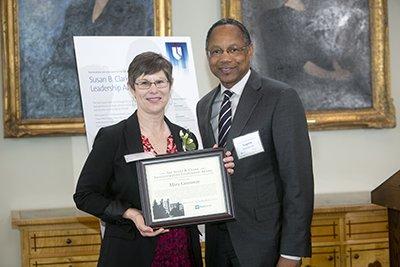
Mary Greenway is awarded Susan B. Clark Administrative Leadership Award
Mary Greenway, executive assistant to Dean Nancy C. Andrews in the School of Medicine, has been awarded the 2015 Susan B. Clark Administrative Leadership Award, a prestigious honor presented annually to a Duke administrative professional who demonstrates the qualities exemplified by Clark during her remarkable career – dedication to the institution, service to others, and personal strength of character.

Duke Cancer Researcher Receives Outstanding Investigator Award
The National Cancer Institute has awarded a prestigious Outstanding Investigator Award to David G. Kirsch, M.D., Ph.D., professor in the departments of Radiation Oncology and Pharmacology and Cancer Biology at Duke Health.
Duke Medical School ranked among the nation’s top 10
Duke University School of Medicine ranked eighth in research and eighth in primary care among all medical schools in the nation, according to new U.S. News & World Report rankings. The School consistently ranks among the top ten medical schools.
Boulware to Receive SGIM Mid-Career Mentoring Award
L. Ebony Boulware, MD, MPH, associate dean for Clinical and Translational Science in the School of Medicine and chief of the Division of General Internal Medicine in the Department of Medicine, was selected to receive the 2016 Society of General Internal Medicine’s Mid-Career Research and Mentorship Award. This award is given each year to honor a superb mid-career clinician investigator who is actively engaged in research and in the mentorship of junior investigators.

Monkeys Drive Wheelchairs Using Only Their Thoughts
Neuroscientists at Duke Health have developed a brain-machine interface (BMI) that allows primates to use only their thoughts to navigate a robotic wheelchair.
A computer in the lab of Miguel Nicolelis, M.D., Ph.D., monitors brain signals from a rhesus macaque.