
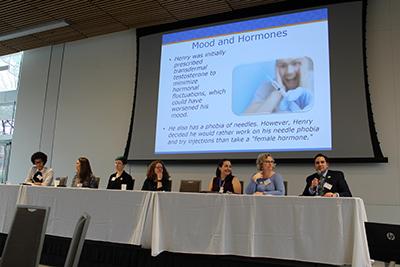
Duke Kicks Off Sexual and Gender Minority Health Program with Symposium
On Tuesday, February 11, an interdisciplinary group of Duke researchers and clinicians launched the Duke Sexual and Gender Minority Health Program at a day-long symposium on the Duke campus. The event featured keynote speakers from the National Institutes of Health (NIH) and panelists from Duke University, the University of North Carolina-Chapel Hill and the Durham community.
Keynote speakers included:

Duke University Among Top 10 in Nation for Federal Medical Research Funding
Duke University continues its leadership in biomedical research, ranking eighth among the nation’s top medical schools and research institutions for funding from the National Institutes of Health (NIH).
Duke received $429.4 million in federal funding from the NIH in 2019, according to the Blue Ridge Institute for Medical Research.
Duke was the largest recipient of NIH grant funding in North Carolina for fiscal year 2019. Eight departments and one basic science discipline ranked among the top ten in country:

7 Duke Experts Answer the Most Pressing Coronavirus Questions This Week
Seven Duke experts—whose specialties range from global and public health to infectious disease, global health policy and mental health—spoke with DGHI about where we are now with 2019-nCoV, addressing important questions on many of our minds.
Now Accepting Applications! Early Career Women Faculty Leadership Development Seminar
The AAMC is now Accepting Applications!
Early Career Women Faculty Leadership Development Seminar
July 11-14, 2020
Hyatt Regency Minneapolis
Minneapolis, Minnesota

Analysis: Use of Fresh Donor Eggs in IVF Has Small Advantage in Birth Outcomes
Using freshly donated eggs for women undergoing in-vitro fertilization (IVF) provides a small but statistically significant advantage in birth outcomes compared to frozen donated eggs, according to a new study led by a Duke Health researcher.
The national study, publishing online Feb. 6 in the journal Obstetrics & Gynecology, was the largest head-to-head comparison of the two IFV approaches, measuring the likelihood of a good perinatal outcome, defined as a single baby without prematurity and with a healthy birth weight.
Register now! Kerfuffles, Conflicts and Misunderstandings: Strategies for Engagement
This interactive session starts with the premise that the capacity to engage skillfully in challenging conversations is a vital component of leadership. The goal of this seminar is for participants to gain greater confidence in addressing difficult conversations.
Click here for more information and to register

Third Year Scholarship Announcement
THE 3RD YEAR INTERNAL SCHOLARSHIP APPLICATION PROCESS IS NOW OPEN!!!
Are you a rising or current third year student? Are considering doing a second third year and would like to know which scholarships are applicable to you?
Welcome to the Internal Scholarship Application 3rd Year portal. All descriptions are located in Canvas, the Third Year website and in the application.
Duke Clinical Research Update February 5 2020
Research Community News
iRIS/OnCore Updates
DOCR News
Recruitment Innovation Corner
Did You Know?
Training Opportunities

New Ingredient in Cocaine Vaccine Shows Promise in Mouse Study
A new ingredient added to a current cocaine vaccine appears to enhance its effectiveness in blocking the drug’s “high” when tested in mice, Duke Health researchers report.
The vaccine, delivered via a liquid nose drop rather than needle injection, includes a new compound that helps the immune systems create antibody responses against cocaine. The findings appear Feb. 5 in the journal npj Vaccines.

How Do We Empower Physician-Scientists?
This year’s School of Medicine Physician-Scientist Symposium featuring Dr. Nancy C. Andrews keynote lecturer Elizabeth M. McNally, MD, PhD, and guest speaker, Director of the NIH Division of Biomedical Workforce, P. Kay Lund, PhD, was a great success with a turn-out of more than 125 students, trainees and faculty from across Duke’s campus. The symposium succeeded in offering a space for MD investigators to network, learn about relevant resources and opportunities, and hear about new and exciting research at Duke and beyond.