

The woman had not spoken for months, advanced dementia having gradually robbed her of the ability to communicate or recognize loved ones. When she was admitted to the hospital with aspiration pneumonia, her family gathered to face the inevitable. A beloved granddaughter rushed across the country to say goodbye.
Then something extraordinary happened.
As the granddaughter entered the room, the woman's eyes focused and brightened. She recognized her. She even spoke her name.
"It was almost as if the grandmother had an awakening, like the clouds parted. The fog lifted and blue sky showed for a time," recalled Heather E. Whitson, MD, MHS, a distinguished professor of neuroscience, director of the Duke Aging Center and co-director of the Duke/UNC Alzheimer’s Disease Research Center.
The lucid episode lasted a few hours, and the grandmother died the next day. But for her family — and millions of others like them caring for loved ones with dementia — such fleeting moments of lucidity can feel almost metaphysical and become treasured memories.
For Whitson, such lucid moments represent one of the most fascinating and least understood mysteries in dementia research.
A New Scientific Frontier
Lucid episodes or paradoxical lucidity — described by researchers as brief, unexpected periods of heightened awareness, communication, or cognitive function in people with advanced dementia — can last minutes or hours before disappearing as suddenly as they begin. Caregivers have described these moments for decades, but scientists still know little about why they happen, or even how to define them.
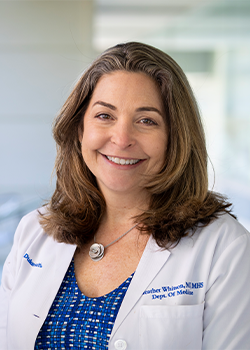
Whitson has joined a team of colleagues, including Andrea Gilmore-Bykovskyi at the University of Wisconsin School of Medicine and Public Health and Dr. Joan Griffin at Mayo Clinic who are working to change that through the NIH-funded Lucidity in Alzheimer's and Dementia (LEAD) Network — the nation's first research consortium dedicated to studying lucidity in Alzheimer's disease and related dementias.
LEAD Network is pioneering a new area of neuroscience by reframing dementia research around memory retrieval and by bringing broader awareness to a phenomenon.
The consortium's work centers on three goals: developing a standardized definition of lucidity, understanding its impact on caregivers and families, and uncovering the neural mechanisms that make these episodes possible.
The network brings together experts like Whitson in neuroscience, psychology, geriatrics, caregiving, data science, and measurement science to establish research standards and accelerate discoveries that could improve dementia care.
"We want to understand what is happening at the level of brain circuits, cells, and molecules," said Whitson, a member of the network's executive committee who is helping to position Duke University School of Medicine at the forefront of this new field.
Sensory Triggers
Researchers suspect sensory triggers — including music, familiar voices, or meaningful personal connections — may play a role, though evidence remains largely anecdotal. But the ultimate objective is to move beyond compelling stories toward rigorous science.
If researchers can identify the biological processes behind lucidity, the findings could extend far beyond fleeting episodes — the same mechanisms that briefly restore communication in advanced dementia might also help protect and sustain, or even recover, cognition earlier in the disease course.
"I really think that a lot of what we learn about these dramatic episodes could have bearing on better cognition and better outcomes throughout the disease," Whitson said.
A major milestone will come this fall, when researchers from across the country will convene at Johns Hopkins to establish national priorities and launch competitive funding opportunities aimed at accelerating discovery.
The mission immediately resonated with Zidan Yang, PhD, a Duke fellow in systems neuroscience who studies human memory in Nanathia Suthana's lab, after experiencing several of episodes of lucidity with her own family members. Yang is among the inaugural participants in the LEAD Network's Rising Star program, which brings together early-career scientists to help shape the future of lucidity research.
In the Suthana Lab Yang investigates how memories are encoded, consolidated, and reactivated during rest and sleep using advanced electrophysiology, neuroimaging and physiological measurements — techniques she believes will help uncover the neural mechanisms behind episodes of lucidity in dementia.
"Dementia is actually not the end of the road. It's not irreversible,” she said. “We can actually do something to reverse it because clearly those people have their memories—they just couldn't access them."
Asking A Different Kind of Question
"We've spent decades focused on preventing dementia and treating dementia," Whitson said. "This research asks a different question: What allows moments of preserved function to emerge, even in the setting of advanced disease?"
The shift is subtle but significant. Rather than asking why the brain fails, the study of paradoxical lucidity is forcing scientists to confront why, under certain circumstances, it appears to recover.
At the heart of that inquiry is the concept of resilience, a long-standing theme and research focus of the Duke Aging Center.
Traditionally, scientists have viewed resilience as the brain's ability to maintain function despite accumulating damage. Lucid episodes suggest something more complex may be happening.
"Neuroscientists often frame cognitive resilience as your mind’s ability to hang on to a capacity even though there is brain damage," Whitson said. "But lucid episodes tell us that even when a capacity seems as if it's lost, it may not be lost forever."
The Substrate
If a person with severe dementia can suddenly recognize a loved one, speak meaningfully, or communicate emotions, then neural machinery supporting those abilities must still exist somewhere within the brain. Researchers often refer to this as a retained "substrate" — the underlying biological capacity for cognition and connection.
"The phenomenon suggests there is still some preserved substrate there," Whitson said. "It means that a profound part of their self – which dementia took away – is still there."
That possibility carries scientific, clinical, and philosophical weight. It suggests that even in advanced stages of disease, individuals may retain capacities that are hidden rather than erased — and that understanding what allows cognition to briefly re-emerge could offer new insight into preserving brain function throughout the course of dementia.
It's also a humbling reminder of how much remains unknown. "We try to use our brains to understand the brain," Whitson said. "It's a really daunting task."