
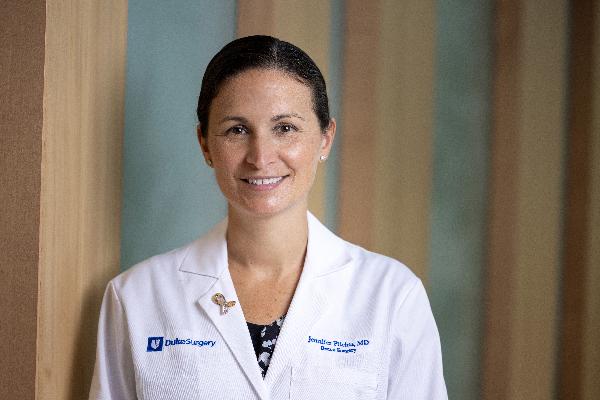
The evolution of personalized medicine has transformed breast cancer care, replacing one-size-fits-all approaches with increasingly tailored strategies. Duke surgical oncologist Jennifer Plichta, MD, MS, is pushing that evolution further — combining data, research, and a deeply patient-centered approach to help patients navigate an increasingly complex landscape of breast cancer risk, prevention, and treatment.
Her philosophy is straightforward: replace assumptions with increasingly precise information about the individual patient.
When Plichta arrived at Duke in 2016 as a fellow from the Dana-Farber Cancer Institute, the Duke High-Risk Breast Cancer Risk Assessment Clinic she directs employed one nurse practitioner. Today, it has three physicians and five advanced practice providers. In 2025, the clinic saw more than 1,000 new patients and 2,000 follow-up visits.
“Nowhere is personalized care more prevalent than in breast cancer care,” said Plichta, the E. Fulton Brylawski Associate Professor in Women's Health and an associate professor in the departments of Population Health Sciences and Surgery. “Everybody's breast cancer gets treated differently. My job is to help them understand what each path looks like and what they can live with.”
Right tool, right time, right patient
Breast cancer care has changed dramatically, from radical mastectomies to breast-conserving surgery and increasingly sophisticated approaches to lymph node sampling. Genetic testing can reveal inherited cancer risk; molecular profiling can illuminate tumor biology; and advanced imaging can detect cancers that traditional screening may miss.
Plichta starts by understanding the whole patient — family history, genetics, medical history, risk factors, and personal preferences — then uses that information to choose the most appropriate tools.
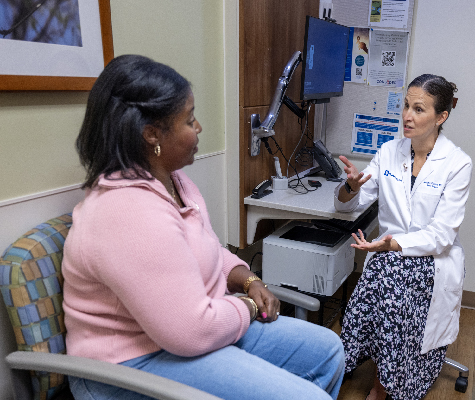
“We have all these tools now, but the key is applying them thoughtfully, choosing the right test for the right patient at the right time,” she said.
For patients at increased risk, a comprehensive assessment may lead to enhanced screening, genetic testing, lifestyle changes, risk-lowering medications, or chemoprevention. It can also identify people who may benefit from testing inherited mutations such as BRCA1 and BRCA2.
Plichta advocates for making genetic testing more accessible, particularly for underserved populations.
“Without widespread genetic testing, individuals with actionable mutations may miss out on targeted treatments that could improve their outcomes, even save their lives,” said Plichta, the E. Fulton Brylawski Associate Professor in Women's Health and an associate professor in the departments of Population Health Sciences and Surgery.
Making cancer make sense
Plichta cares for patients with breast cancer, benign breast conditions, and elevated breast cancer risk, including men. But her influence extends beyond the clinic. As a researcher, she is challenging conventional thinking about metastatic breast cancer and staging.
Some of Plichta’s research focuses on metastatic breast cancer and how staging can improve patient care and education, her research demonstrating that outcomes can vary considerably among patients with metastatic disease.
She developed a four-tier staging system that offers a more nuanced prognosis for patients diagnosed with metastatic breast cancer at the time of initial presentation.
Unlike the traditional approach, which classifies all new metastatic breast cancer as stage IV regardless of tumor characteristics, Plichta’s system incorporates factors such as tumor biology and disease spread to distinguish four prognostic groups.
The Plichta staging system, first published in the Annals of Surgery in 2020, originally proposed three prognostic groups (A, B, and C) and later modified with the Joint Committee on Cancer (AJCC) breast panel to include four groups (IVA, IVB, IVC, and IVD). A final validation cohort, presented during the Society of Surgical Oncology 2024 Annual Meeting, demonstrated a consistent decrease in overall survival rates with an increasing stage group.
The validation of this staging system marks a significant step forward in the understanding and management of de novo metastatic breast cancer, Plichta said. The goal is to provide a clinical tool that can guide treatment decisions and improve outcomes for patients.
For patients, that distinction can matter. Some people with metastatic disease live substantially longer than traditional stage IV statistics might suggest, while others face a more aggressive course.
“This work is meant to be a foundation, and I hope people continue to build on it,” said Plichta, whose dedication to breast cancer extends beyond clinical and research interests.
Plichta recently won an NIH grant that addresses a critical gap in oncology. While extensive research exists on preventing initial breast cancer recurrence, standardized frameworks for evaluating and predicting survival after recurrence remain limited.
Plichta and co-investigator Dr. Kathryn Pollak will identify key predictors and standardize assessments for post-recurrence survival in patients with recurrent breast cancer. The goal is to create clearer educational expectations and tailored management plans to help patients and providers navigate treatment goals when managing recurrent or metastatic disease.
Community education
Plichta learned early in her Duke career how much personalized assessment can matter.
Plichta also has a passion for educating the community about breast cancer and helping to raise money for breast cancer research and education.
She is the creator of Duke’s free, annual breast education community day, What’s Best for Breasts? each fall. This year's event on Saturday, October 3, includes presentations and interactive information sessions about breast imaging, genetic testing, breast cancer risk assessment, breast cancer 101, breast reconstruction, survivorship, and more.
One of Plichta’s first patients at Duke had a strong family history of breast cancer and was considering a preventive mastectomy because of her elevated risk. Although Plichta was not convinced surgery was warranted, the patient qualified for enhanced screening. Using risk models, Plichta recommended a breast MRI, which detected an early-stage cancer that had been missed on mammography.
Finding the cancer before surgery changed the treatment approach. Unlike preventive surgery, cancer surgery includes evaluation of the lymph nodes, allowing the patient to receive the appropriate cancer-directed care from the start.
“We found her cancer early. She’s doing great. Without that MRI, her cancer would have kept growing,” Plichta said.
The experience reinforced the value of looking beyond standardized screening recommendations. In this case, understanding the patient's individual risk led to additional imaging — and an earlier diagnosis.
“Those cases also remind me that for every cancer we catch early, there are others we’re likely preventing,” she said.
For Plichta, personalized care is ultimately about bringing together the pieces that make each patient different — risk, biology, history, circumstances, and preferences — and using them to make cancer a little more understandable.