
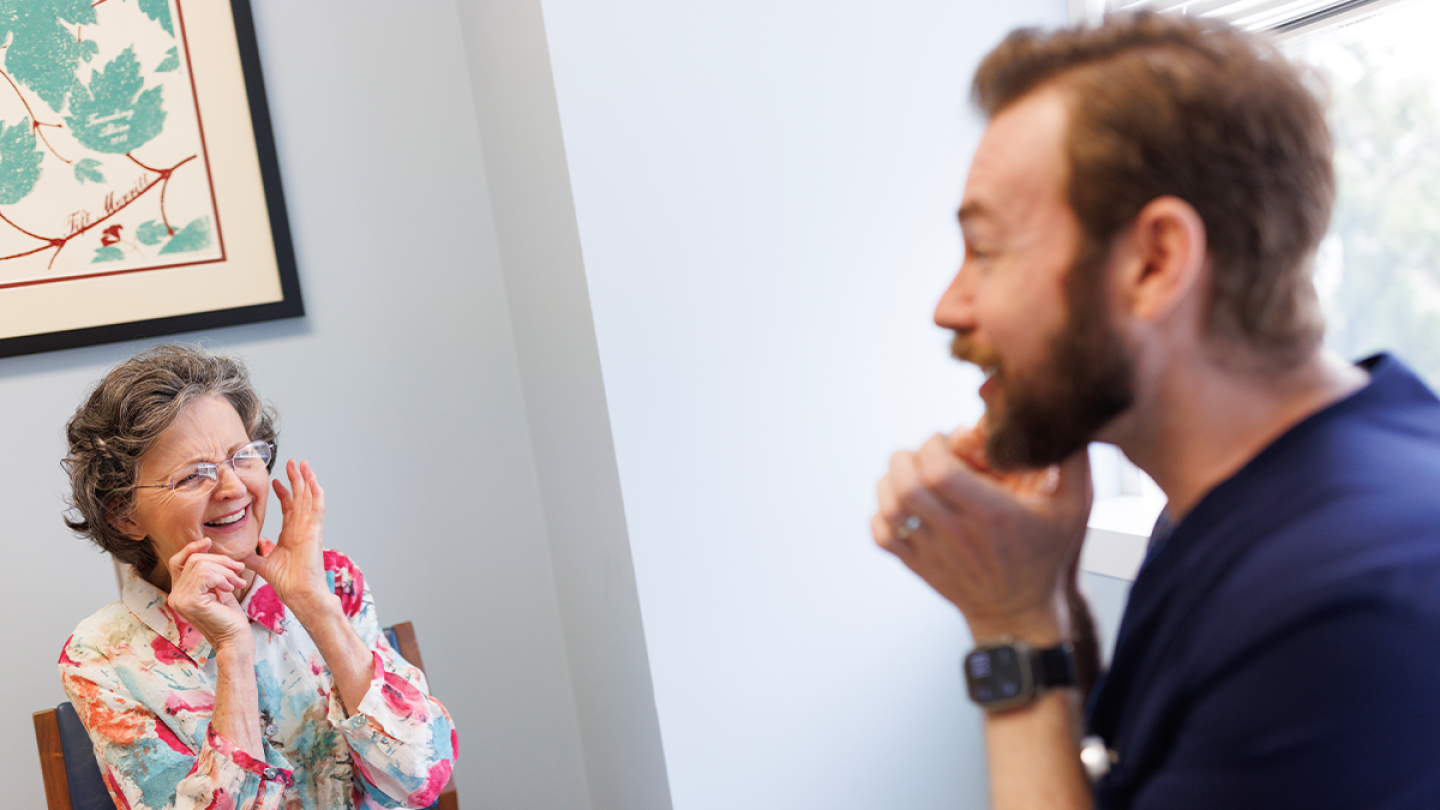
The Science of Getting Your Voice Back
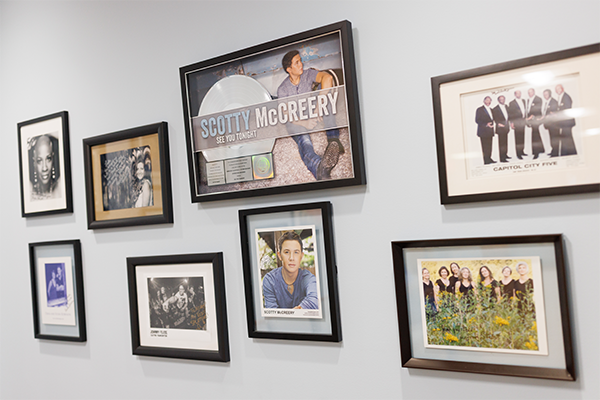
Photos of singers line the walls of the Duke Voice Care Center, but its patients extend far beyond professional vocalists. For 20 years, the center has helped people regain a voice that sounds like their own.
Many are teachers, grandparents, church choir members, cancer survivors, and others who simply want to communicate with ease. They come seeking a return to everyday moments, from leading a classroom to chatting over dinner.
"Our voice is part of our identity," said Leda Scearce, MM, MS, CCC-SLP, a speech-language pathologist and director of Performing Voice at the Duke Voice Care Center (DVCC). "When your voice changes and no longer sounds like you, that can have a huge emotional impact. Communication is how we participate in the world."
Most people rarely think about their voice until something goes wrong. For older adults, age-related voice changes can start as early as their 50s, with symptoms such as hoarseness, vocal fatigue, tremors and shifts in pitch making conversations harder. Even a few days of laryngitis can leave anyone feeling isolated.
The Duke Voice Care Center has helped patients regain that connection through a combination of specialized medical care, advanced technology, and voice therapy. Scearce has been there since the beginning.
Before the DVCC, patients with voice problems navigated a fragmented system. A patient might see an ear, nose, and throat physician, then wait weeks for a separate appointment with a speech pathologist for additional testing and therapy.
"It was a clunky process," Scearce said.
David Witsell, MD, MHS, professor emeritus of the Head and Neck Surgery & Communication Sciences, recognized the need for a better approach. He partnered with Scearce and speech pathologists Gina Vess, MA, CCC-SLP, and Caroline Banka, MS, CCC-SLP, to create an integrated voice center where physicians and speech pathologists could work side-by-side.
"The support of Dr. Danny Jacobs, chair of the Department of Surgery, and Dr. Ramon Esclamado, chair of the Division of Otolaryngology-Head and Neck Surgery, was instrumental in being recognized as a distinct multidisciplinary center within the Duke Health system and Duke Hospital," he said. "This recognition catalyzed the innovation and outreach that helped make the DVCC one of the most successful patient-centered voice centers nationally."
Seth Cohen, MD, MPH, a fellowship-trained laryngologist, was recruited to round out the team, and on July 1, 2006, after months of planning, the Duke Voice Care Center officially opened.
A Team Approach to Voice Care
Two decades later, that collaborative model remains the center's defining strength. The team now includes two laryngologists, a pediatric otolaryngologist, and 11 voice-specialized speech-language pathologists working across five Duke locations. The Duke Voice Care Center is one of the largest specialized voice centers in the country.
Patients are evaluated by both laryngologists, doctors who are specially trained in voice disorders, and speech pathologists who focus on voice care.
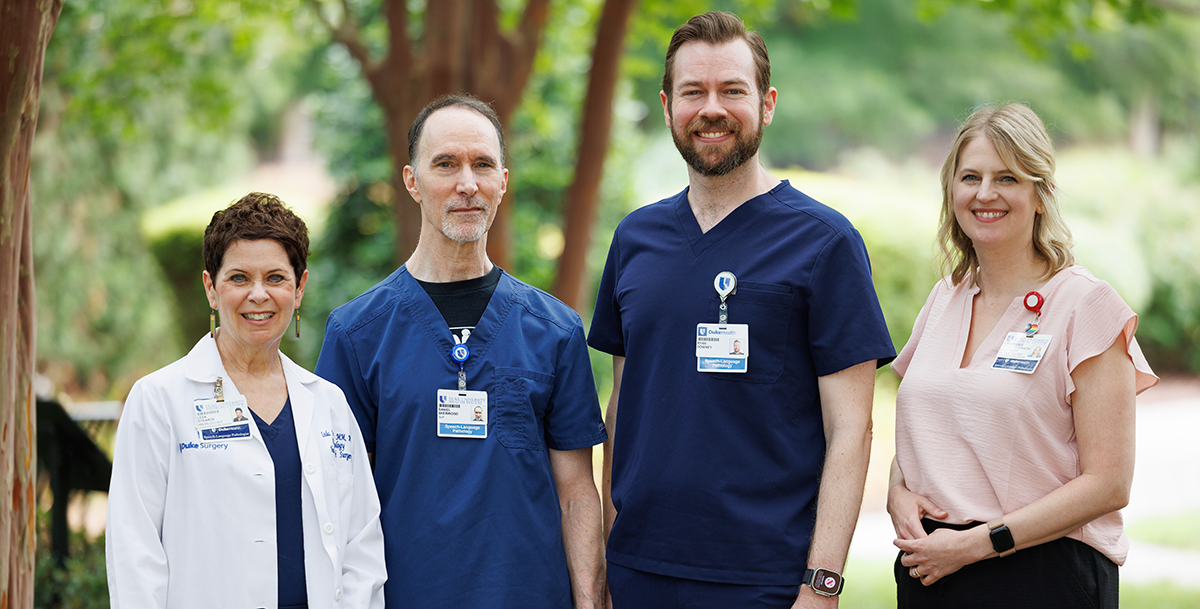
"We go into the room and take the patient's history together," Scearce said. "Then the laryngologist conducts a head and neck exam before moving on to other patients."
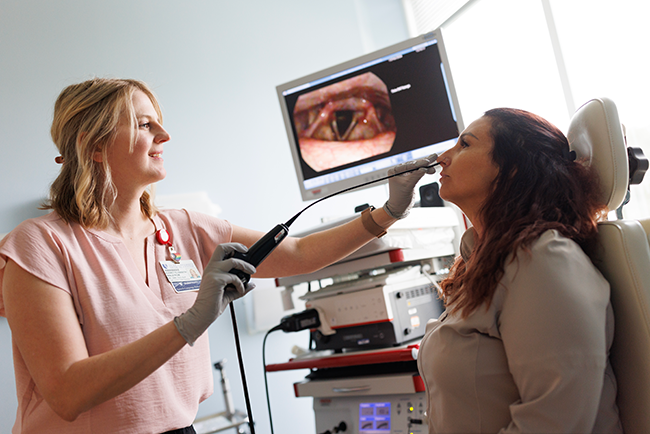
The speech pathologist talks with the patient about how the voice problem affects daily life, then uses a small camera to examine the vocal cords. The procedure called videolaryngostroboscopy, or “strobe,” allows clinicians to see how the vocal folds function during speech.
Afterward, the speech pathologist and laryngologist review the findings together with the patient, explain the diagnosis, and discuss treatment options.
The streamlined process eliminates weeks of uncertainty and gives patients a clear path forward during a single visit.
"The close work between speech pathologist and laryngologist is part of what makes the Duke Voice Care Center so unique," said Lauren Fay, MS, CCC-SLP, a senior clinician at DVCC. "We can offer coordinated care because we're seeing patients together and constantly collaborating."
When the Voice Stops Working
Providers at the Duke Voice Care Center treat four broad categories of voice disorders: benign vocal fold lesions, muscle tension dysphonia, neurological disorders, and cancer.
Benign vocal fold lesions, including nodules, polyps, cysts and scar tissue, are among the most common voice disorders. They often develop from repeated strain on the vocal folds.
Scearce, a former professional opera singer and singing teacher who now specializes in voice rehabilitation, compares them to athletic injuries. "Just like an athlete putting superhuman demands on the body can get injured, the voice can get injured too," she said
While some lesions require surgery, many improve through voice therapy, where patients learn more efficient ways to use and protect their voices.
Another common condition is muscle tension dysphonia (MTD), in which the vocal folds appear structurally normal but muscles in the throat have begun compensating inefficiently. Patients often experience tightness, discomfort, a sensation of a lump in the throat, increased effort with speaking or swallowing, and hoarseness.
"Because we can't see inside our throats, these symptoms can be upsetting and lead to unnecessary worry," said Vess, director of clinical operations for the DVCC. "The good news is that we have very effective strategies to help. We often see significant improvement within a few therapy sessions."
For Vess, the results are often visible before they're audible.
"They come back looking more relaxed. They're smiling, and you can see the relief."
Neurological Conditions and the Loss of Connection
Neurological disorders can dramatically affect voice. People with Parkinson's disease, for example, often develop increasingly soft speech without realizing how quiet they have become. Therapy focuses on helping them intentionally project and speak louder than feels natural.
Vocal fold paralysis is another common neurological condition. Because the nerve controlling the vocal folds follows a long path through the body, it can be damaged during thyroid, lung, or heart surgery.
When a vocal fold becomes paralyzed, a gap may form between the folds, allowing air to escape. The voice can sound weak or breathy, and swallowing may become difficult.
Sometimes paralysis resolves over time. In other cases, surgeons reposition the vocal fold using injectable materials or permanent implants.
"The functions of the larynx are breathing, speaking, and swallowing, and all are impacted by vocal fold paralysis," said Cohen, medical director the DVCC. "We can perform procedures in the clinic and operating room to restore these functions and improve quality of life."
Voices of patients with vocal tremor or spasmodic dysphonia may sound shaky or strained. For some, the condition does more than alter speech.
It gradually narrows their world, making conversation so exhausting or embarrassing that they begin to withdraw from it altogether. But silence carries its own risks. Because “isolation can affect people’s health,” Scearce said, therapists encourage patients to keep talking rather than slow down or avoid speaking.
Rebuilding a Voice
Some patients with laryngeal cancer undergo surgery that removes part or all of the larynx.
Speech pathologists help many regain communication through tracheoesophageal (TEP) speech, in which air is redirected from the lungs into the esophagus through a voice prosthesis to create sound. They also help patients learn to use and maintain the device over time.
"Many times, the new voice can sound so natural that others think the person simply has a cold," Vess said. "They don't realize the person no longer has vocal cords."
For many patients, a diagnosis confirms something they have already begun to fear: their voice is no longer working the way it once did.
That was the case for Barbara Hall, a vocalist and choir director who sought help from the Duke Voice Care Center after a church convention in 2024.
During a choir rehearsal, Hall's voice suddenly cracked and popped. She had already been dealing with medication-related dryness and severe allergies. The changes were also beginning to affect her job as a grants and contracts administrator at Duke University, where speaking was an essential part of her day.
She was referred to voice therapy and connected with Scearce, whom she had worked with nearly 15 years earlier after a bout of vocal overuse.
"When I started my sessions with Leda, I was at my lowest expectations for what could be achieved," Hall said.
Once comfortable singing across a wide vocal range, she suddenly found herself struggling to reach notes she had previously sung with ease.
Over six months of therapy, her voice slowly returned.
A Straw, a Bubble, and the Future of Voice Therapy
Many patients at the DVCC leave therapy sessions doing something unexpected: speaking and singing through straws.
"It seems crazy," Scearce said with a laugh, "but it's probably the hottest research topic in voice science."
Known as semi-occluded vocal tract exercises, or SOVT exercises, the technique uses the narrow opening of a straw to create resistance and improve vocal efficiency. Some patients blow bubbles through the straw into water while making sounds.
Hall became very familiar with the approach.
"One of the main exercises was straw-in-water phonation to strengthen my vocal muscles," she said. "It also helped make sure I was breathing correctly to vocalize properly."
Over time, the exercises progressed from blowing bubbles in water to performing vocal glides and scales through the straw. Therapy also included other exercises and techniques designed to restore the rich tone needed for gospel music. The exercises improve airflow, reduce strain on the vocal folds, and help the body produce sound with less effort.
By the end of therapy, Hall's vocal range had largely returned with minimal strain. More importantly, she said, the experience changed how she thinks about her voice.
"My voice is an instrument," Hall said. "Just like band members ensure their mechanical instruments are in great shape for performances, it’s important that I treat my vocals likewise.”
Photography by Eamon Queeney, assistant director, multimedia & creative in the Office of Strategic Communications at the Duke University School of Medicine.