
A Pocket-Sized Diagnostic with Global Reach

When a Duke University-led team of doctors and engineers traveled to western Kenya in January, they carried a device small enough to slip into a coat pocket — and ambitious enough to reshape how cervical cancer is diagnosed worldwide.
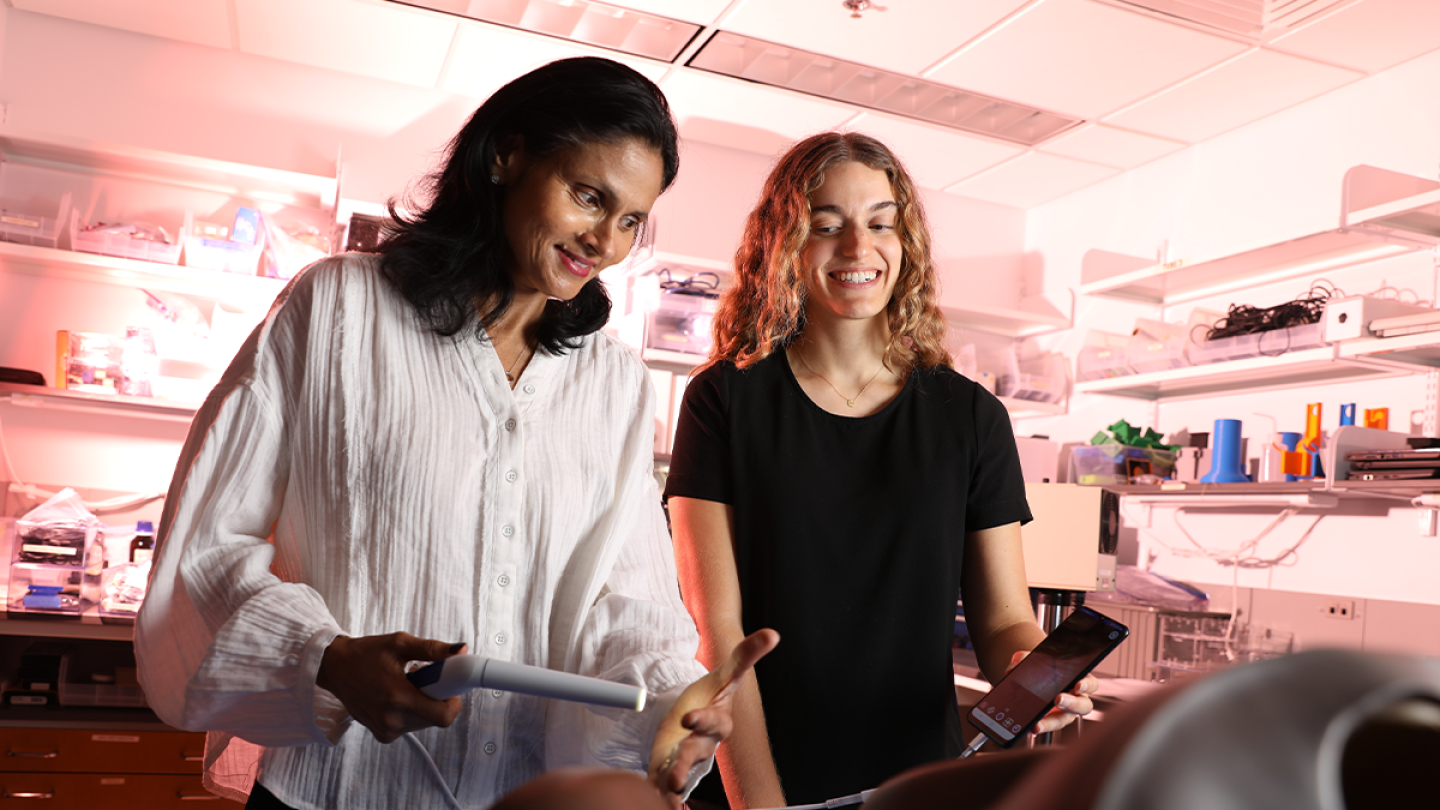
The Pocket Colposcope, a handheld cervical imaging device developed at Duke, was originally designed for settings where traditional diagnostic tools are scarce or prohibitively expensive. Now enhanced with artificial intelligence (AI), its potential extends far beyond global health, offering a more accessible, patient-centered approach to care that could benefit women everywhere.
By rethinking how — and where — cervical cancer diagnosis happens, Duke researchers are working to bring high-quality diagnostic care closer to patients without compromising standards.

“That’s the holy grail,” said Megan Huchko, MD, MPH, professor of obstetrics and gynecology at Duke University School of Medicine, and director of the Duke Center for Global Reproductive Health. “If we can bring the quality of diagnosis closer to what women receive at places like Duke — without requiring the same infrastructure — that’s a real win.”
Cervical cancer is among the most preventable cancers, yet it remains one of the deadliest for women globally. While screening tools such as human papillomavirus (HPV) testing have made enormous strides in identifying women at risk, the next step — accurate diagnosis after an abnormal screening result — remains a major bottleneck.
In high-resource settings, that diagnosis typically relies on colposcopy and biopsy, procedures that require specialized equipment, trained clinicians, pathology services, and multiple patient visits. In many parts of the world, those resources simply don’t exist.
“The gap isn’t screening anymore — it’s diagnosis,” said Huchko, a practicing gynecologist who has worked in Kenya for nearly two decades. “In too many settings, there is no reliable way to confirm what a screening test suggests. That leads to over-treatment, fear, and confusion for patients.”
The Pocket Colposcope was built to change that equation.
Bridging Medicine and Engineering
The project is the product of a long-standing interdisciplinary collaboration between Huchko and global health researcher Nimmi Ramanujam, PhD, professor of biomedical engineering at Duke Pratt School of Engineering and director of Duke Center for Global Women’s Health Technologies. Co-investigators include partners from the Kenya Medical Research Institute and Purdue University.
The two began working together nearly a decade ago on an earlier version of the device. Since then, their teams have bridged clinical medicine, engineering, and data science to tackle one of the most persistent challenges in cervical cancer prevention: determining which women truly need treatment.
Using deep learning, cervical images captured by the Pocket Colposcope are analyzed to assess whether visible changes are likely to represent disease requiring treatment or are safe to monitor. The goal is to support clinicians with real-time decision-making — enabling screening, diagnosis, and treatment in a single visit.
“In many places, there simply is no pathologist available,” Huchko said. “We needed a tool that could approach the predictive accuracy of a biopsy without requiring one.”
With support from a major National Institutes of Health grant, the team is now integrating AI directly into the Pocket Colposcope’s clinical workflow — a critical step toward broad, real-world use.
Adding Intelligence to Imaging
Beyond affordability and portability, the Pocket Colposcope offers something transformative: visual clarity.
“For women, it’s incredibly powerful to see what a provider is talking about,” Huchko said. “It improves understanding, trust, and increases uptake of care.”
Through multiple design iterations, the device has been optimized to capture high-quality images at the point of care, whether in a tertiary hospital or a rural health clinic. Images can be stored, reviewed, and used immediately to guide clinical decisions.
A recent study in western Kenya deployed the Pocket Colposcope in routine clinical care, collecting thousands of images across multiple sites. Those data helped fuel development of the Colposcopy Automated Risk Evaluation (CARE) algorithm, a decision-support tool designed to work alongside clinicians — not replace them.
Reconsidering Medical AI
Applying AI to cervical cancer diagnosis presents unique challenges, and the Duke team is intentionally taking a different approach.
Rather than focusing solely on algorithmic accuracy, the CARE system incorporates both a risk assessment and a confidence score, allowing clinicians to interpret results in context. Providers contribute image annotations and clinical insights, enabling engineers to refine the algorithm while making uncertainty visible.
“Algorithms are often treated like diagnostic black boxes that just spit out an answer,” said Ramanujam. “But they’re only as good as the data that go into them. Our goal isn’t just accuracy — it’s confidence.”
If the algorithm signals low confidence, she added, that information itself has clinical value.
By deploying AI-supported Pocket Colposcopes in local health departments and primary care clinics, providers can better stratify risk, keep patients in familiar settings, and reserve specialty referrals for those who truly need them.

the Duke Center for Global Women’s Health Technologies (GWHT) as they build technology and confidence in cervical cancer screening.
Global Lessons, Local Impact
Kenya — where cervical cancer rates are nearly six times higher than in the United States — is a critical proving ground for the technology. But the implications reach much closer to home.
In rural and underserved areas of the U.S., women often travel hours for follow-up colposcopy after an abnormal screening result. A portable, AI-supported diagnostic tool could help close that gap.
As the team returns to Kenya with the latest version of the AI-boosted Pocket Colposcope, their work reflects what’s possible when global health, engineering, and clinical medicine move forward together — intentionally and in partnership.
“Innovation has to earn trust,” Ramanujam said. “Technology can help close health care gaps — but only if it’s developed thoughtfully, and alongside the people who will use it.”
Liz Switzer is a communication strategist at Duke University School of Medicine.