

Beyond basketball
Since its founding in 1997, the Michael W. Krzyzewski Human Performance Laboratory (K-Lab) has focused on understanding the complexities of human movement and performance.
The K-Lab was established through the efforts of the Duke Department of Orthopaedics with support from legendary Duke basketball coach Michael Krzyzewski, who played a pivotal role in securing initial funding from Nike.
Perhaps because of its celebrity moniker -- and the fact that members of the Duke Men’s Basketball program visit the lab for pre-season biomechanics testing -- there can be misconceptions about the K-Lab. Even though its walls are adorned with sports memorabilia and a plaque signed by Coach K that reads "To the K-Lab team: I am very proud to be working with you! We have many wins ahead of us!" the mission of the lab goes far beyond Duke Athletics.
Today, in addition to its focus on human performance and injury prevention, the lab is also a core research facility serving Duke physical therapy students, Duke researchers, and scientists beyond Duke, driving innovation in orthopaedics, physical therapy education, geriatrics, and even neurosurgery.
Keep it moving
The K-Lab is directed by Lou DeFrate, Sc.D, who holds appointments in both the School of Medicine and the School of Engineering. Under his watch, the lab has grown into a multidisciplinary research hub, with a diversity of projects having one thing clearly in common – movement.
“It’s exciting to see the range of projects now under way, each contributing to our understanding of human movement in different contexts,” said DeFrate.
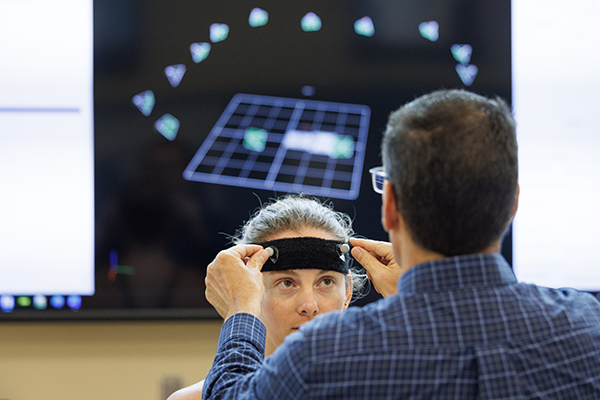
Work led by DeFrate has integrated measurements in the K-Lab with advanced imaging tools to investigate what movement patterns put the ACL at risk for injury. Specifically, his team is using these techniques to examine what motions stretch the ACL the most, making it most susceptible to injury. This work has led to a project funded by the National Institutes of Health aimed at understanding what factors put female athletes at higher risk for ACL injury compared to male athletes. They hope that a better understanding of the risk factors for injury will ultimately improve the efficacy of efforts to prevent these devastating injuries from happening.
The lab’s work with Duke orthopedics researchers has enhanced surgical techniques, prosthetic designs, and rehabilitation programs. For example, Ned Amendola, MD, and his team have worked with the K-Lab to obtain objective biomechanical patient movement measurements following knee replacement surgery. This collaboration gives insights into how to tailor rehabilitation and recovery strategies for patient to ultimately improve clinical outcomes.
Neurosurgeon Nandan Lad, MD, PhD, secured NIH funding to investigate electrical stimulation techniques for individuals with spinal cord injury. This research examines the use of implanted devices that deliver targeted electrical impulses to the spinal cord and their effects on pain, motor, sensory, and autonomic function. As part of this multidisciplinary effort, the K-Lab provides critical biomechanical assessments to objectively quantify outcomes and characterize responses to stimulation. This work contributes to a growing body of research exploring the potential of spinal cord stimulation to support improvements in function, mobility, and quality of life for individuals with spinal cord injury.
Recent studies by Laura Pietrosimone, DPT, PhD, the K-Lab’s assistant director, are using small, wireless sensors that can detect gait alterations, such as those caused by knee swelling. By simulating this condition through saline injections, her team can observe how changes in movement can be tracked outside of traditional lab settings, enabling data collection in clinical and field environments.
Ahead of the game
Housed in the Doctor of Physical Therapy (DPT) division in the Department of Orthopaedic Surgery, the K-Lab also plays an important role in the education mission of the School of Medicine.

Bella Schmukal is in her third year of the DPT program at Duke. Originally from Dallas, Texas, she played volleyball in college and said she knew early on that she wanted to be a physical therapist. “It’s a common story,” she laughs. “I had sports injuries in high school and went through rehabilitation. That experience solidified my interest in physical therapy.”
Schmukal was introduced to the K-Lab during her first semester in the DPT program, when the entire class of 104 students had the opportunity to study gait mechanics using motion-capture technology and force plates—instruments that measure the forces generated between the body and the ground during walking or running.
Later, she and other students worked with research analyst Tim Lindsay, PhD, during pre-season assessments with the men’s basketball team, testing the athletes leg strength, biomechanical techniques, and movement patterns. These evaluations—ranging from vertical to lateral jumps—pinpoint muscle imbalances, optimize push-off power, and evaluate landing technique.
“I had never been exposed to technology like that,” Schmukal said. “I saw how it could be used both in research and clinically. The fact that we were exposed to this during our first semester was amazing and crucial for that initial learning stage.”
Todd Cade, PT, PhD, is a professor in the Department of Orthopaedic Surgery and leads Duke’s physical therapy doctorate program. Learn more about the program here.
For more information about the K-Lab’s research and services visit the website.
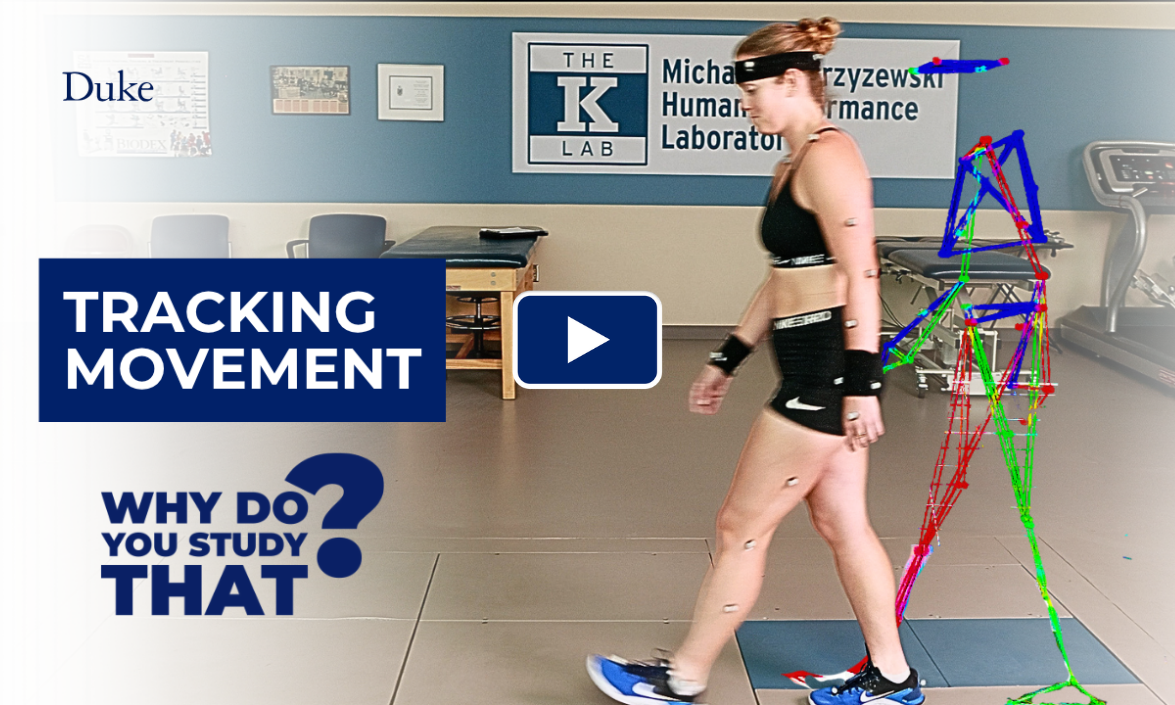
Why do you study that? K-Lab researchers demonstrate their work
Research reported in this publication was supported by the National Institute of Neurological Disorders and Stroke and the National Institute of Arthritis and Musculoskeletal and Skin Diseases (AR082665), both part of the National Institutes of Health The content is solely the responsibility of the authors and does not necessarily represent the official views of the National Institutes of Health.