

Duke University School of Medicine hosted its first Climate and Health “Big Idea” Symposium on January 22, bringing together faculty and trainees from across campus to share ideas aimed at addressing the health impacts of climate change. Hosted by the Climate and Health Research Initiative (CHeRI), the event highlighted the importance of interdisciplinary collaboration and the need to address climate‑related risks facing vulnerable populations.
The day featured a keynote address, a showcase of current research projects funded by CHeRI, and a session where teams pitched “big idea” concepts focused on tackling emerging climate‑driven health challenges.
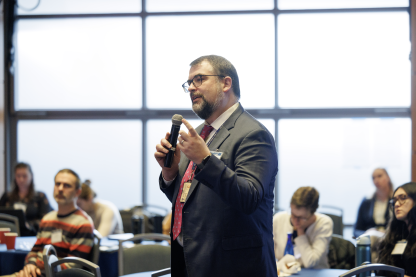
Climate‑focused collaboration
In opening remarks, Mary E. Klotman, MD, executive vice president for health affairs and dean of the School of Medicine, emphasized Duke’s university‑wide commitment to climate and the urgency of integrating research with climate resilience and health-focused solutions.
“Often when we think of climate change, we think in terms of the economy or the environment, but we don't think in terms of health,” she said, noting that extreme heat, flooding, and water scarcity directly threaten human health.
Klotman encouraged Duke researchers to remain focused, collaborative, and undeterred by external challenges.

A need for solution‑driven research
Participants also heard from keynote speaker Mary B. Rice, MD, MPH, director of the Center for Climate, Health, and the Global Environment (C-CHANGE) at Harvard T.H. Chan School of Public Health. Rice shared examples of the center’s work — from clinical trials examining home air purifiers for patients with COPD to developing heat and smoke action plans and piloting a cool roof intervention in South Africa.
Rice said action taken in the past to better understand the harmful effects of tobacco use and create health warnings can serve as an example for fossil fuel use today. She wrapped up her presentation by emphasizing the need for researchers to move beyond identifying problems to focusing on solutions and implementation.
Showcasing innovation
A panel of researchers showcased pilot projects funded by CHeRI, each addressing climate‑related health challenges in North Carolina and beyond:
-
SEEDS Health Atlas: A data platform helping communities and researchers understand the connection between health and where a person lives, identify populations at greatest climate risk, and design targeted interventions.
-
Duke/NC4Health: A coalition aimed at bridging academic research and community emergency preparedness, including development of a disaster response resource map using Hurricane Helene as a case study.
-
Environmental Exposures and Kidney Health (EEKH): A project examining climate‑related kidney risks — affecting roughly 15% of the global population — and exploring heat‑exposure policies and wearable technologies as interventions.
-
Duke Climate & Fungi (CLIF): A team studying how post‑flood fungal growth affects health. Their fungal biobank, developed from samples collected in Black Mountain, North Carolina, supports research into both fungal‑related disease risks and underexplored therapeutic potential.
-
Duke Immunology and Climate Change Exploration (DICE): A project investigating climate impacts on the immune system, with goals of developing biomarker screening tools and community-focused implementations, such as personalized health plans.

-
CUIDAR: A dissertation project by PhD student Elizabeth Rojo, MA, focused on heat risks faced by U.S. farmworkers. With no federal heat‑protection standards in place, Rojo aims to support community‑designed interventions that ensure access to basic protections such as water, shade, and rest.
New “big ideas”
In a forward-looking session, faculty and graduate students pitched new “big ideas” for the next round of CHeRI‑funded projects, which will be selected in April.
The Climate and Health Research Initiative is supported by a $4.5 million award from The Duke Endowment.