
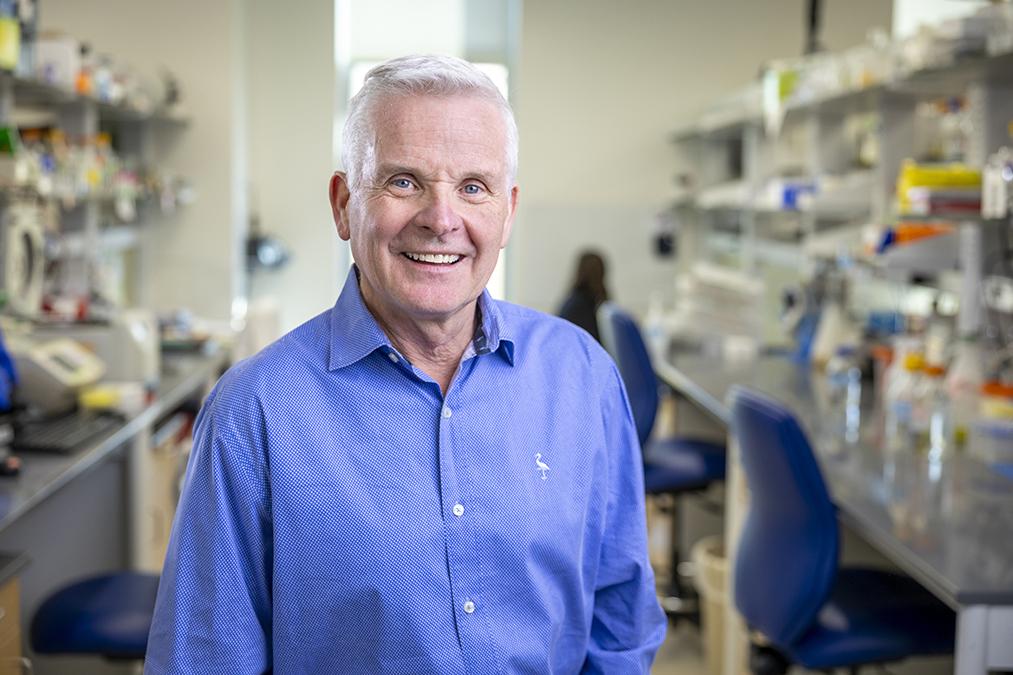
Described as a serial inventor, Duke University School of Medicine’s Donald McDonnell, PhD, brings decades of research expertise and a host of discoveries and inventions, including the discovery of an entirely new class of medications: oral selective estrogen receptor downregulators, or SERDs.
McDonnell and his collaborators continue to search for treatments for the most stubborn cancers that defy traditional standard of care.
McDonnell makes it clear that science is a long game: after thirty years of research exploring mechanisms to target cancer cell growth, “it's really only now that the fruits of these long-term investigations are coming to light.” Most recently, his discoveries have been licensed to pharmaceutical companies for development and commercialization, producing two new drugs for metastatic breast cancer, elacestrant (FDA approved) and lasofoxifene (Phase 3 clinical trials) - the second remarkably developed by a graduate student as a side project.
His work with prostate cancer treatment follows the same path, “fundamental research looking at why patients fail standard of care therapy,” eventually pushing them to “heretical, out-of-the-box ideas.” Having spent part of his career in the pharmaceutical industry, McDonnell appreciates the opportunity afforded by an academic institution like Duke to study, over the long term, fundamental science that can lead to a solution never before considered.
After many years of discovery, McDonnell is excited about the future. “The buzzword right now is immunotherapy,” he explains, because “in some respects cancer and cancer progression is a failure of the immune system.”
There’s also the elusive “silver bullet,” precisely targeted therapies. McDonnell’s work has expanded to radiopharmaceuticals, drugs that include a radioactive molecule that targets and eliminates the cancer cell. Taking on cancer at the cellular level has the potential to completely revolutionize treatment.
He is also hopeful about the future of AI to streamline research. With AI assisting with mundane tasks like summarizing articles, or the overwhelming tasks like analyzing massive data sets, “there's always going to be a role for ingenuity.”
McDonnell credits his exceptional lab, currently made up of 22 graduate students, postdoctoral fellows, research scientists, and non-tenure track faculty. Between partners with tenures of more than 25 years and new grad students and post-docs, McDonnell’s lab combines research continuity with fresh, enthusiastic perspectives and an interest in translational work, getting medications and therapies out of the lab and into use.
The unique character of Duke as an academic medical center, and his close relationship with the physicians at Duke, also informs McDonnell’s work. “Now, that doesn't mean that drugs go directly from my lab to those patients,” he explains, “but what it means is that patients and their experience are helping us to mold and structure our research programs.” In fact, McDonnell notes, his lab meetings frequently attended by medical oncologists who provide context and real-world application.
McDonnell's work will be showcased at Invented at Duke 2026, hosted by Duke’s Office for Translation & Commercialization on November 17, 2026.