
On the Scene with the Associate Dean: BIOTRAIN 720
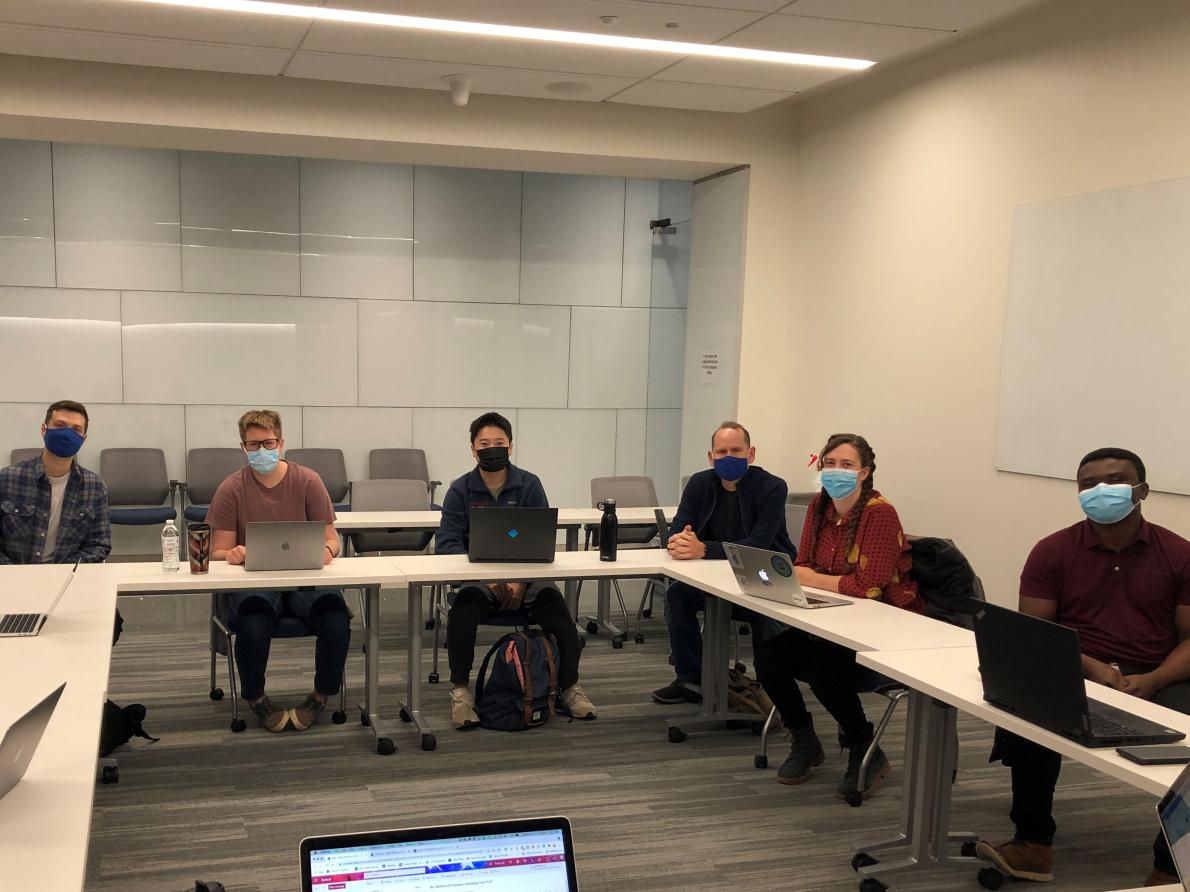
BIOTRAIN 720 Genome Engineering, Epigenetics, and Disease Study Section
A recent shift for NIH-funded T32 graduate training programs, especially those supported by the National Institute for General Medical Sciences (NIGMS), has been to emphasize trainee focused educational objectives. PhD students in T32-funded programs are expected to attain technical (research) operational (skills), and professional (career) competencies that prepare them for entering diverse careers. An expected operational and professional competency is the ability to “communicate scientific research methodologies and findings to a wide variety of audiences (e.g., discipline-specific, across disciplines, and the public)”, particularly scientific writing.
About 11 years ago, Dr. Douglas Marchuk, James B. Duke Professor in Molecular Genetics and Microbiology and UPGG Director at the time, developed what has become the biomedical PhD programs’ flagship grant writing course. Marchuk explained the training need, “in academics, faculty members spend much of their time and effort writing grant proposals to fund their research. And yet, we felt that this important skill was not being taught…it is critically important that the students learn what is expected of a written grant proposal from the perspective of the reviewers”.
The grant writing course also helps students to develop their thesis research projects and prepare them for the preliminary exam. Marchuk believes the two objectives of the course reinforce each other. “Having students write and review their own proposals leads to stronger proposals and a knowledge of what is important for reviewing them,” he explains.
The course covers basic components of an NIH grant, strategies for writing compelling Specific Aims pages and Significance and Innovation sections, principles of study section grant review, and how to write and respond to a grant review critique. Small group sessions, i.e. mock study sections of up to 12 students and one study section faculty chair, provide students with interactive group feedback on Specific Aims and Significance and Innovation sections. Mock study sections also review full proposals in NIH study section fashion. Each original proposal and its revision receive formal critiques by a guest faculty reviewer and two student study section members. Marchuk notes “we include guest faculty reviewers to model what goes on during real grant review, but in the end, the students are the most rigorous reviewers.”
After ~5 years of offering this course to MGM and UPGG students who extolled its value in preparing for fellowship submissions and prelims, other SoM PhD programs expressed interest in the course. Since 2015, the course enrolls not only UPGG and MGM trainees, but also students in Neurobiology, Pharmacology, Molecular Cancer Biology, Cell Biology, Immunology, Pathology, Biology, Biomedical Engineering, and Integrated Toxicology and Environmental Health PhD programs. As the course expanded, the logistics of organizing multiple study sections and securing faculty reviewers became increasingly complex. In 2020, OBGE partnered with Marchuk to offer the class centrally to all SoM PhD programs under the course code BIOTRAIN 720
For Fall 2021, 70 students enrolled in the course and 59 faculty participated as lecturers, guest reviewers, or study section chairs. To all the students who took BIOTRAIN 720, you worked incredibly hard both writing and critiquing proposals, and I thank you for your diligence and commitment to elevating your critical thinking and scientific writing skills. I also acknowledge the faculty who provided expert feedback on scientific content and grantsmanship – without your participation, this course is impossible.
Finally, as BIOTRAIN 720 Course Director and chair of the Genomic Engineering, Epigenetics and Disease study section, I offer special gratitude to the faculty who devoted 18+ contact hours by serving as study section chairs: Brigid Hogan (Cell, Stem Cell and Developmental Biology), Micah Luftig, Jorn Coers, and John Rawls (Infectious Disease and Immunology), Steve Lisberger and Jeremy Kay (Neurobiology), Doug Marchuk (Genetics and Genomics), and Bernard Mathey-Prevot (Cancer Biology and Pharmacology).
As the semester and another successful iteration of BIOTRAIN 720 ends, I wish everyone a wonderful holiday season and all the best for the New Year.
THANK YOU TO 2021 BIOTRAIN 720 FACULTY PARTICIPANTS!
(* denotes Study Section Chairs/Co-Chairs):
Soman Abraham
Allison Ashley-Koch
Gerald Blobe
Nicolas Brunel
Nicole Calakos
Romain Cartoni
Jen-Tsan Ashley Chi
Jorn Coers*
Chris Counter
Greg Crawford
Lawrence David
Fred Dietrich
Anita Disney
Cagla Eroglu
Greg Field
Scott Floyd
Lindsey Glickfield
Simon Gregory
Brent Hanks
Nick Heaton
Matt Hilton
Matt Hirschey
Brigid Hogan*
Cort Hull
Jeremy Kay*
Cindy Kuhn
Andrew Landstrom
Steve Lisberger*
Craig Lowe
Micah Luftig*
Dave MacAlpine
Doug Marchuk*
Bernard Mathey-Prevot*
Donald McDonnell
Eva Naumann
Chris Newgard
Ann Marie Pendergast
John Rawls*
Tim Reddy
Jessica Sawyer
Dave Sherwood
Mari Shinohara
Debby Silver
Scott Soderling
Beth Sullivan*
Purushothama Tata
David Tobin
Nina Tsvetanova
Raphael Valdivia
Xiao-Fan Wang
Anne West
Andy West
Laura Wingler
Kris Wood
Greg Wray
Colleen Wu
Huanghe Yang
Tso-Pang Yao
Zhao Zhang