
OTD Class of 2027 Celebrates Transition to Fieldwork

Forty‑three Duke Doctor of Occupational Therapy (OTD) students marked a defining milestone in their professional journeys during the Duke OTD Commissioning Ceremony, held Friday, May 1. The ceremony formally recognized the Class of 2027 as they transitioned from classroom learning into fieldwork, capstone experiences, and expanded clinical practice grounded in service, dignity, and care.
Often described as a moment of both celebration and responsibility, commissioning represents a formal “sending out”—an affirmation that students are prepared to step into new roles with trust, authority, and purpose.
“Commissioning is an act of entrusting,” said Sarah Jean Barton, ThD, MS, OTR/L, BCP, Program Director of Duke OTD. “It is both a celebration of who these students are and a mark of confidence in the service they are prepared to offer the world.”
Seeing People as People
Central to this year’s ceremony was a shared reminder that occupational therapy is rooted in humanity and relationships.
“Our clients are not problems to be fixed or abstractions to be managed,” Barton said. “Occupational therapists see people as people—with inherent needs to engage in meaningful activities within their families, communities, and cultures. When those needs are met, health and well‑being follow.”
That theme was echoed by Tia Clark, co‑chair of the Coalition of Occupational Therapy Advocates for Diversity (COTAD), who emphasized the responsibility practitioners carry as they enter practice.
“Our clients are real people—people who need help, respect, and care,” Clark said. “They rely on practitioners who truly see them.”
Speakers throughout the ceremony reflected on the evolving role of occupational therapists as leaders who meet complexity with curiosity, clarity, and compassion. Students were encouraged to view uncertainty not as an obstacle, but as part of meaningful, responsive care.
“To be commissioned into this work means upholding a deep holism,” Barton said. “It means considering systems, environments, histories, daily routines, and human experience—all at the same time, every time.”
Marking Growth, Resilience, and Readiness
Remarks also honored the personal and collective growth students experienced during the didactic phase of the program—acknowledging moments of challenge, perseverance, and transformation.
“You are resilient—even when you didn’t always recognize it in yourselves,” said Alexandra Armstrong, vice president of the Student Occupational Therapy Association (SOTA). “But you made it through. You are here.”
Barton reminded students that readiness does not require perfection.
“Occupational therapy is not about getting everything right,” she said. “It’s about showing up to each part of the day with attention and intention—doing with, never doing to or for.”
Bianca Banez, president of SOTA, encouraged classmates to move forward with openness and courage.
“Go with your eyes open and embrace what’s ahead,” she said. “The path will ask much of you—but you are ready.”
The Blue Coat and the Pin
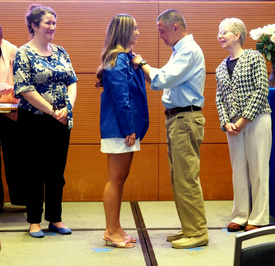
A centerpiece of the ceremony was the presentation of the Duke OTD Blue Coat, followed by a Duke OTD lapel pin presented by someone meaningful to each student—parents, siblings, partners, mentors, or close friends.
“The Blue Coat represents the distinct perspective occupational therapists bring to health care,” Barton said. “It is a reminder that OT stands out—bringing approaches, insights, and outcomes that are essential and uniquely human‑centered.”
The pin, featuring a teleidoscope design, symbolized the complexity of daily life and the importance of participation in meaningful occupation.
“The pin honors not only your professional knowledge,” Barton added, “but also the people who walked alongside you to get here and the many parts that come together in every human experience.”
By accepting their Blue Coats and pins, students reaffirmed their commitment to ethical practice, service, and lifelong learning—values at the core of the Duke OTD program.
Looking Ahead
As the Class of 2027 advances into fieldwork and capstone projects, faculty leaders encouraged students to remain grounded in purpose, connection, and humility.
“You may have spent years exploring your path,” said Kayla Thomas, co‑chair of COTAD, “but now you are becoming someone who will help others discover theirs.”
The Duke OTD Commissioning Ceremony serves as both a rite of passage and a reaffirmation of the program’s mission: to prepare occupational therapists who lead with skill, creativity, compassion, and deep respect for lived experience.
“This ceremony is our confidence‑filled sending out,” Barton said. “And our reminder that the world is ready for what these students are commissioned to offer.”