
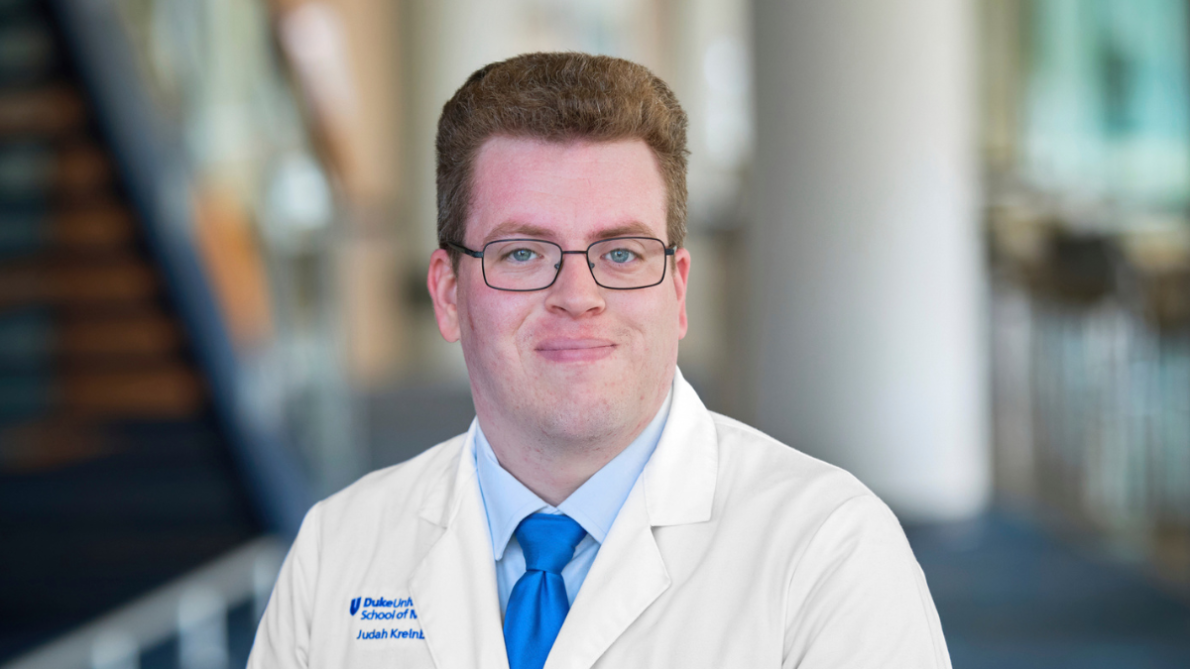
Judah Kreinbrook, Master of Health Sciences in Clinical Research, Clinical Research Training Program
Hometown, State
Ocala, Florida
What inspired you to pursue this degree?
Prior to arriving at Duke as a medical student, I had participated in industry funded trials as a clinical research coordinator and conducted some of my own projects as an undergraduate student. I quickly recognized the need to understand the entire process of clinical research, particularly study design and interpretation. In clinical medicine we are often very quick to believe strongly in a particular treatment or approach even as the evidence lags. Another major motivating factor is my area of interest: out of hospital cardiac arrest. My primary mentor in this space, Dr. Monique Starks, had also pursued the MHS in clinical research as a cardiology fellow. The fact that I was being given the opportunity to receive this training early as a medical student was all the motivation I needed to sign up.
Why did you choose Duke?
Prior to arriving as an admitted medical student in 2022, I had specifically accepted Duke over my other choices because of available clinical research training. I've always been a bit precocious and wanted to get my clinical research training early, allowing my experiences in medical school and residency to result in plenty of questions to be pursued later on. When I visited the Triangle, the close by hiking and unique character of the nearby cities was very attractive. You can go from a farmer's market to a nearby film screening to downtown Raleigh within the same day and go hiking the second.
Do you have a favorite memory from your program?
Wow there are so many that it's hard to choose. One that comes to mind occurred in both CRP 266, a study in advanced methods for non-randomized studies, as well as an independent course I took in observational studies. I remember realizing, for the first time, how many assumptions we have to make to infer causation from observational evidence.
How do you hope to make an impact with your career?
I aspire to become what I call a "methodologically-informed" investigator whose disease of focus is resuscitation science, the study of cardiac arrest. One of the major challenges of all clinical research, but especially resuscitation science, is that statistical assumptions and methods are described in statistical language but difficult to translate into clinical language. Resuscitation is especially challenging, as observational studies make up the majority of the evidence base and many of these are poorly conducted. My goal is to focus on how we can improve the conduct of observational studies in this space.
What was the most important thing you learned at Duke?
That good clinical science requires admitting that you don't know far more often than I previously thought. I've definitely adapted the motto that "Good science results in more questions."