
Empowering students to lead financially
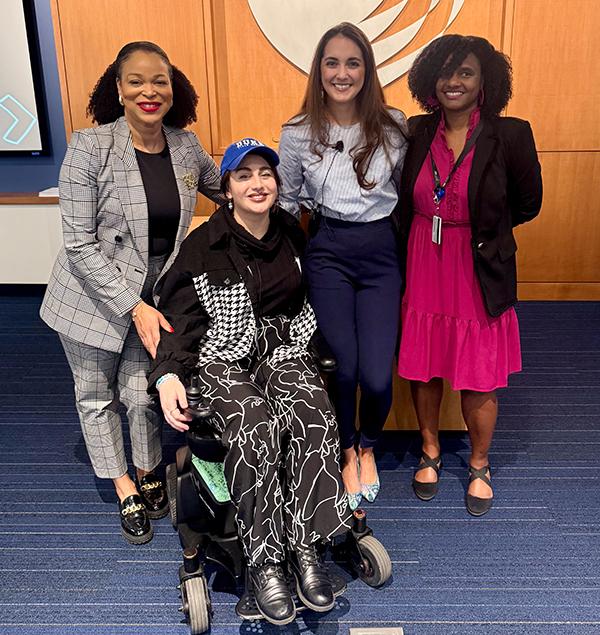
When Tiffany Adams, PT, DPT, MBA, PhD, was a physical therapy student, navigating loans, budgeting, and managing debt felt like stumbling in the dark. The same was true for Tomeico Faison, OTD, OTR/L, FAOTA, during her time as an occupational therapy student. Both came from families where financial literacy wasn’t commonplace, making the process of funding their education anything but intuitive.
Now as leaders within health professions programs at Duke, the two decided to change that narrative for today’s students. Nearly five years ago, they partnered to create the Duke OTD & DPT Financial Leadership Series, an initiative designed to empower future health professionals with the knowledge and strategies they never had.
Recognizing the high cost of Duke’s programs and the disparities in debt burden, Adams and Faison launched the series in 2021 to equip students in Duke’s Doctor of Physical Therapy (DPT) and Occupational Therapy Doctorate (OTD) programs with proactive strategies for financial success.
The purpose of the series is to educate DPT and OTD students on topics such as loan forgiveness, budgeting, tackling debt, generating multiple streams of income, investing, and alternative ways of funding education.
“Our desire is that they make better financial decisions,” said Adams, assistant professor in the Department of Orthopaedic Surgery and director of leadership and organizational culture. “That may look a couple of different ways — from reducing the amount that they’re borrowing, if possible, so that it reduces their debt burden to having them start to think about long-term implications of their financial decisions today.”
“We want students to recognize the value of a Duke University education while also having access to resources that enable them to successfully finance and pay off the debt that makes this opportunity possible,” said Faison, assistant professor in the Department of Orthopaedic Surgery and director of innovation in professional pathways.
Adams and Faison chose the term “financial leadership” rather than the traditional term “financial literacy” to emphasize continuous growth and empowerment.
“Literacy implies that there's a stop point,” Adams said. “Leadership implies that this is a constant journey where you're seeking to grow and learn to improve your financial knowledge to help you make better decisions.”
Student-Driven Topics and Expert Voices
Adams and Faison looked to the students to learn what topics were most meaningful.
The sessions feature experts — often alumni — who understand both financial counseling and the realities of health professions.
“We try to find PTs and OTs who are also credentialed certified financial counselors or experts,” Adams said. “We find that when individuals have just the financial counsel without the understanding of what debt burden really looks like in our health professions, as well as some of the structural challenges that our graduates are navigating, sometimes the information isn't always usable or transferable. So, we're trying to focus on people who know both worlds.”
“Many students feel overwhelmed by the amount of debt they carry, and it is important for them to hear real stories of individuals who have not only significantly reduced their student loan debt but have completely eliminated it,” Faison said.
Attendance has been strong, with the most recent session on loan repayment drawing about 100 students, the most attended session since the series began.
In the alumni-led session titled, “Vocational Rehabilitation as a Source of Funding for Students with Disabilities,” students learned how vocational rehabilitation can provide critical financial and structural support during their educational journey.
Adams said to help address burnout in the two professions, the series also aims to expose students to career options that generate income in non-traditional ways.
For example, in one session, students heard from occupational and physical therapists who have had success as social media influencers.
Addressing Urgent Challenges
Typically, sessions are held once per semester. However, in spring 2026, the series will be held twice because of urgent challenges with federal loan caps for health professions students.
The U.S. Department of Education’s Reimagining and Improving Student Education (RISE) Committee recently capped federal student loans at $20,500 per year for graduate students. Medical degrees have been designated as professional degrees. But all other doctoral programs, including physical therapy and occupational therapy programs, have been designated as graduate degrees.
Adams said federal loan caps will push students toward private loans, making creditworthiness critical.
“Private loans rely heavily on credit worthiness,” Adams said. “A solution is equipping people with strategies to improve their credit worthiness. So, what are tangible, simple, easy things that people need to know and do? We’ve assumed for so long that people just know this, but what we’re learning through talking to our students is they don’t.
“As we think about the implications from an economic disparities perspective, there's a possibility that we're going to see the disparate impact of that change on different communities,” Adams said.
To help students better understand the implications of these changes, upcoming sessions will focus on improving credit scores and preparing for privatization of student loans.
Looking ahead, Adams and Faison hope to expand the series to include prospective students, offering guidance before enrollment decisions.
“We have to think outside the box, do different things than we’ve done in the past, and pull ideas from other industries,” Adams said.