
From Classroom to Conference: Lindsay Durdle, CO’26, Shares Her OTD Scholarship on Participation and Access

After presenting work on participation, access, and adolescent mental health, a Duke OTD student shares how conferences helped broaden her perspective on occupational therapy’s role worldwide.
As a Duke Doctor of Occupational Therapy (OTD) student, Lindsay Durdle CO’26 has embraced opportunities to share her work beyond the classroom—presenting at national and international conferences and engaging in meaningful conversations about access, participation, and well-being. Her experiences reflect a growing commitment to advancing occupational therapy’s role not only in treatment but also in prevention, education, and systems-level change.
Durdle has presented research in two main areas, both focusing on participation and access across different ages. Her first project, a scoping review, examined experiential, occupation-based methods in elementary education to determine how they can help reduce occupational marginalization among children. She presented this with her peer, Ashleigh Burn, at SSO:USA in 2024 and at the American Occupational Therapy Association (AOTA) Annual Conference in 2025.
Recently, her scholarly work aligned with her capstone project, which investigates nature-based occupations and their impact on adolescent mental health. She shared this research at the World Federation of Occupational Therapists (WFOT) Congress in 2026, offering a Duke OTD perspective to a global audience.
“Across both experiences,” Durdle explained, “my focus has been on how occupational therapy can go beyond treatment to support prevention, well-being, and system change.”
Durdle’s desire to present as a student stems from her strong belief that student research is relevant beyond academic requirements. With a history of consistent research engagement throughout her education, she aimed to continue and share her work in graduate school.
“I saw that the projects we do as students can be applicable in many settings,” she said. As I realized how my work connected to larger field discussions—especially about mental health, access, and prevention—it became clear that I should contribute to those conversations.”
For her, presenting was also an early way to actively participate in the profession, rather than waiting until she felt fully established.
A Global Outlook at WFOT
Among her conference highlights, Durdle highlights the WFOT Congress in Bangkok as particularly meaningful. Attending and presenting at a global event expanded her understanding of how occupational therapy varies worldwide and prompted her to rethink the profession’s scope.
“Many conversations focused on systems-level thinking, prevention, and how everyday environments influence health,” she shared. “That experience reinforced that my capstone is part of a larger, ongoing conversation.”
It also encouraged her to consider broader spaces beyond traditional clinics, where barriers to participation are actively discussed and addressed.
Conference presentations have significantly contributed to Durdle’s professional development. Preparing to speak helped her move beyond personal knowledge to clearly articulate the relevance and impact of her work.
“It shifted my mindset from just completing a project to considering its impact and fostering discussion,” she explained. “It helped me find my professional voice and participate in larger conversations, which are vital for leadership.”
She notes that these experiences boosted her confidence, improved her communication skills, and underscored the importance of thoughtful contributions to occupational therapy’s evolution.
Advice for Fellow OTD Students
For other Duke OTD students hesitant to submit or present, Durdle offers simple yet powerful advice: just submit and go.
“She said, “There’s real value in sharing your work and simply being present in those spaces. You’re exposed to new ideas, practice innovations, and broader conversations shaping the field.”
She stresses that presenting is part of learning, and being open to feedback only helps growth. Sharing her research has expanded her knowledge, built confidence, and created connections within the OT community.
“Following your curiosity and engaging early can reveal your growth areas and future contributions,” she concluded. “Those experiences can profoundly shape your career journey.”
-
 An elephant sanctuary in Thailand offers a powerful setting to reflect on occupational balance, highlighting the role of purpose, environment, and rhythm in daily life.
 -
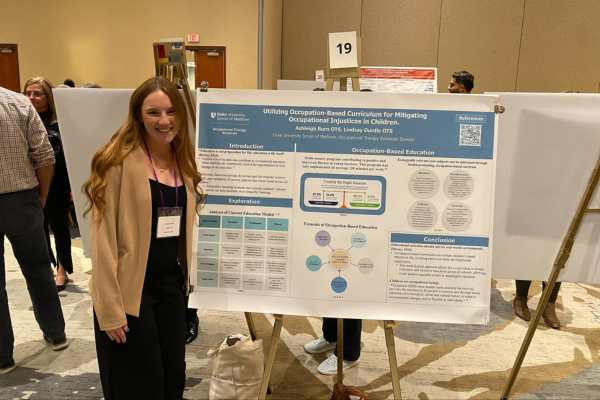 Sharing research at the AOTA Annual Conference poster session in Philadelphia.
 -
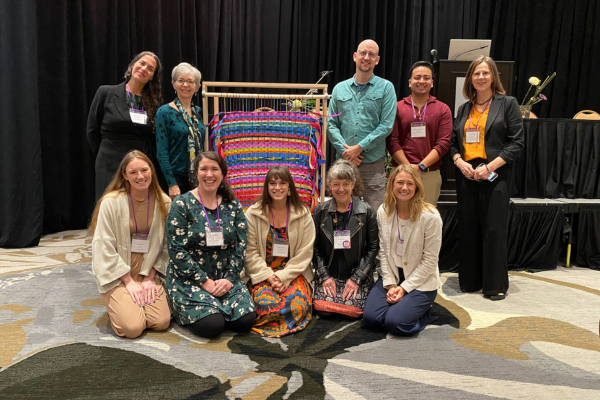 Duke faculty and students representing Duke at the SRS meeting, engaging in research, education, and collaboration.
 -
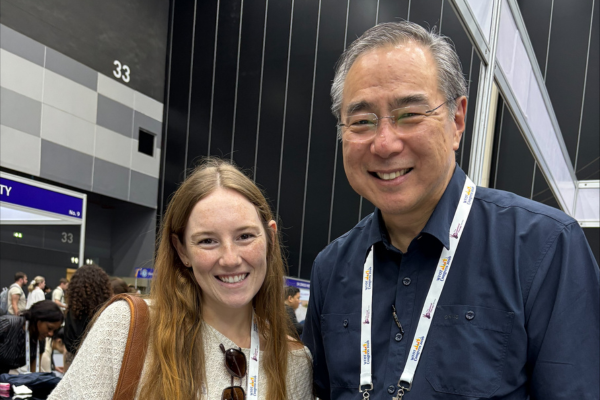 Lindsay Durdle and Dr. Michael Iwama at the World Federation of Occupational Therapists (WFOT) Congress.