
From burnout to belonging: A restorative approach in pediatrics
The pandemic changed the way we work and relate to one another, bringing burnout and stress for many — effects that linger years later. In 2023, a group in the Duke Department of Pediatrics came together to do something about that. They were determined to find better ways to help people feel connected, build relationships, and address conflict.
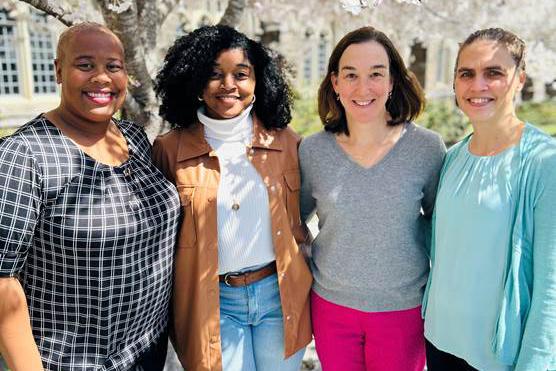
That year, Jasmine Willis-Wallace, EdD; Katy Bartlett, MD; Catherine Hart, MEd; and Sydney Allgood, MBA, participated in a yearlong fellowship through the Office for Faculty. As a team, they began piloting community building restorative practices across the department, conducting structured conversations, known as circles, with leadership groups, divisions, and departmental units. The approach was well received, and requests quickly increased. With support from a grant from the Office for Culture, Engagement, and Impact, the team expanded their efforts into the Restorative Practice Ambassador Program, which has trained more than 30 ambassadors who have conducted 17 circles to date.
Building Community Through Connection
The ambassador program aims to empower faculty and staff across roles — not just those in traditional leadership positions — to model civility, build community, deepen connection, and respond to conflict restoratively.
“When they hear restorative practice, a lot of people think of restorative justice, which is dealing with conflict and harm,” said Hart, education manager for the Office of Pediatric Education. “Restorative practices are bigger than that.”
Rooted in traditions from Indigenous communities, restorative practices focus on building strong relationships, creating space for all voices, and responding to conflict in ways that strengthen, rather than damage, community.
“Interactions matter and impact others,” Hart said. “There's a web of relationships, and whatever one person does impacts the whole community.”
Training Ambassadors, Expanding Impact
The program uses a train-the-trainer model to build capacity for facilitating proactive community-building circles across the department. The first cohort of 19 ambassadors completed training in 2025, followed by a second cohort of 14 that finished this spring.
Participants learn how to facilitate restorative circles within their divisions and work units. Circles are structured conversations designed to help groups build trust and connection by listening to one another in an equitable space. They aren’t meant to solve problems or assign blame.
Bartlett, professor of pediatrics and vice chair for faculty, said restorative practices help address conflict earlier before it has a chance to escalate.
“People are turning more to us as a way to approach issues that come up and help set relations right,” Bartlett said. “Whereas before, sometimes those issues would fester until the relationships were so damaged it was hard to repair them.”
Over the past two years, the department has conducted more than 50 restorative practice circles.
A Space for Authenticity
While circles are common in education settings, Willis‑Wallace said they are far less familiar in academic medicine, yet their impact has been clear.
“One of the things that always surprises me is how willing people are to be authentic and vulnerable,” Bartlett said. “Typically, people aren’t very vulnerable in the workplace.
“People have cried in circles,” she said. “And others have said, ‘I never knew that about my colleague. I feel like I understand them so much better now.’”
Bartlett also described a division experiencing significant conflict that used a harm‑repair approach rooted in restorative practices.
“It really helped bring harmony back to that division,” she said, “and helped people feel connected — like they were all in this together, as opposed to ‘us versus them.’”
Growing the Work
Following the first cohort, the team conducted surveys, focus groups, and session feedback to refine the curriculum. The updated program now goes beyond learning how to facilitate circles to emphasize cultivating a restorative mindset.
“A circle is just one tool in the bigger picture of restorative practice,” Hart said.
The leaders of the ambassador program have since expanded their work to include conflict resolution services and an intranet site where employees can request support.
“We always approach this work with the idea that we’re not here to solve your problem,” said Willis‑Wallace, assistant professor of pediatrics and vice chair of organizational culture and experience. “We're here to provide a space for people to talk through it and provide some tools so we can move towards a resolution.”
Next, the team plans to focus on restorative leadership training for division chiefs, senior business managers, and others.
“We can circle all day,” Willis-Wallace said. “But if we don't give our leaders who are leading these units the tools to be restorative in their leadership, then we have missed.”
Supporting Learners
Although residents, interns, and students aren’t currently part of the ambassador program due to time constraints and turnover, they remain a central focus. Bartlett and Hart are leading a parallel restorative pedagogy effort to help faculty apply restorative practices in teaching and clinical learning environments.
“There has been a lot published in education literature around the importance of the learning environment and for learners to feel safe and have a voice,” Bartlett said. “We want to work with educators to figure out how to make the clinical learning environment a restorative place.”
“A lot of times in medical education, people feel like they have to be perfect and can't make mistakes,” Hart said. “There can be a huge sense of shame. Modeling authenticity and vulnerability, being able to say, ‘I don’t know everything,’ really helps create a safe learning environment.”